
Aretej: drama

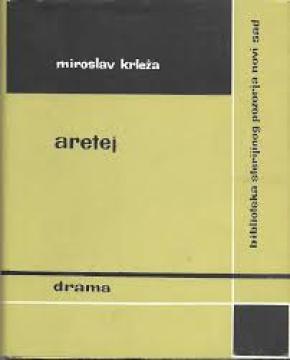
Aretej: drama

Miroslav Krleža

Krleža's drama with an extensive afterword by Branko Hećimović, biobibliographic contributions by Slavko Batušić and photos of scenes from "Areteja" performed by the National Theater, Belgrade.

In the play Aretêj, Miroslav Krleža creates a powerful portrait of the doctor Aretêj of Cappadocia, a man who, despite the chaos of the world around him, stubbornly adheres to an ethical principle: to save a person, regardless of their class, religion or political affiliation. The action is set in the late Roman Empire, during the persecution of Christians, social turmoil and moral decay. It is this historical framework that serves Krleža as a mirror of modernity — a dramatic portrayal of a man who remains committed to knowledge and humanity while the world surrenders to hatred and irrationality.

Aretêj finds himself between two fires: the Roman authorities, cruel and pragmatic, and the Christian communities that, although persecuted, show their own intolerance. His desire to help everyone brings him into conflict with both. At the heart of the play is his belief that a person is valuable for the very fact that he is a person, and not for belonging to a group. This is why the systems of power see him as a threat.

In Aretei, Krleža combines lyricism and thought: in his monologues one can feel the weariness of a man who sees the decline of values, but also the firm conviction that “a doctor must never stop healing”. The fate of the sick, wounded and rejected is depicted in dramatic scenes, and Aretei among them remains the last point of humanity.

Aretei is at the same time a historical picture and a philosophical drama, one of the highlights of Krleža's tragic literature. Through the fate of an individual who does not agree to hatred and ideological blindness, Krleža builds a universal story about resistance, moral responsibility and the price paid by a man who refuses to give up on good.

Ilustracije
Bogdanka Poznanović
Dimenzije
21 x 17 cm
Broj strana
161
Nakladnik
Sterijino pozorje, Novi Sad, 1963.
 
Latinica. Tvrde korice s ovitkom.
Jezik: Hrvatski.

Jedan primjerak je u ponudi

Stanje:Korišteno, u odličnom stanju
Dodano u košaricu!
 

Zanima Vas i neka druga knjiga? Možete pretražiti našu ponudu pomoću tražilice ili prelistati knjige po kategorijama.

Možda će Vas zanimati i ovi naslovi

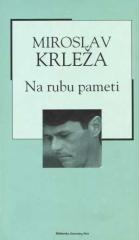
Na rubu pameti

Na rubu pameti

Miroslav Krleža

The novel "On the Edge of Reason" (1938) is Krleža's only novel in the first person. A doctor of law morally condemns a powerful industrialist at a banquet, thereby provoking a general social boycott, persecution, and his own downfall.

Jutarnji list, 2004.
Hrvatski. Latinica. Tvrde korice s ovitkom.
5,26 - 5,62
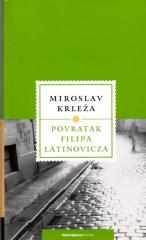
Povratak Filipa Latinovicza

Povratak Filipa Latinovicza

Miroslav Krleža

The Return of Filip Latinovicz is one of Miroslav Krleža's most famous novels. This novel is significant in our literature because it is considered the first fully modern Croatian novel.

Večernji list, 2004.
Hrvatski. Latinica. Tvrde korice s ovitkom.
5,52 - 5,56
Hrvatski bog Mars

Hrvatski bog Mars

Miroslav Krleža

The Croatian god Mars brings seven anti-war novels in which Krleža portrays war as a cruel, senseless machinery that destroys the "little man", exposing the hypocrisy of militarism and myths about heroism.

Rad, 1965.
Srpski. Latinica. Broširano.
1,99
Tajne sretnoga života

Tajne sretnoga života

Susan Meissner

With vivid storytelling and lovely prose, Meissner weaves an interesting story, told from three perspectives, in which World War II and the present day intertwine.

Znanje, 2017.
Hrvatski. Latinica. Broširano.
3,32
Judita

Judita

Marko Marulić

Judith by Marko Marulić is an epic poem about a brave widow who, through her beauty, faith, and wisdom, saves her people by seducing and killing the Assyrian military leader Holofernes.

Zagrebačka stvarnost, 1995.
Hrvatski. Latinica. Tvrde korice.
9,36
Zaplakala stara majka Džaferbegova: Drama u 3 čina

Zaplakala stara majka Džaferbegova: Drama u 3 čina

Jakša Kušan

A three-act drama by Jakša Kušan based on the motifs of the famous Bosnian sevdalinka of the same title, it is one of Kušan's early dramatic works inspired by the Muslim environment of Bosnia.

Tiskara braća Jakšić, 1942.
Hrvatski. Latinica. Broširano.
9,74