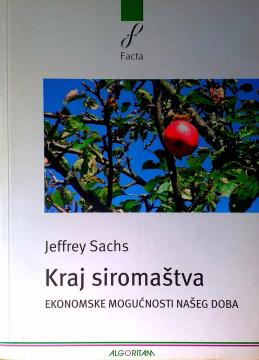
Kraj siromaštva: Ekonomske mogućnosti našeg doba

Kraj siromaštva: Ekonomske mogućnosti našeg doba

Jeffrey Sachs

In the book, economist Jeffrey Sachs presents an optimistic plan for eliminating extreme poverty by 2025. He argues that this is feasible with political will, because world wealth is growing, and poverty is not fate, but the result of inefficient systems.

Sachs introduces "clinical economics" - a systematic approach to treating a disease: diagnosis of the problem, prescription (interventions), and monitoring. He focuses on the poorest countries in Africa, Asia, and Latin America, where billions of people live on less than $1 a day. Key causes: geographical barriers (tropical diseases, droughts), lack of investment in infrastructure, education, and health, and political instability.

He proposes a three-pronged plan: (1) Urgent aid for the "big fight" - networks for malaria prevention, AIDS, distribution of seeds and fertilizers for agriculture; (2) Long-term development - building roads, schools, clinics; (3) Global cooperation - increasing support from rich countries to 0.7% of GDP for development aid, debt cancellation, and non-discriminatory trade rules.

The book is replete with case studies: Sachs's success in Bolivia (1985, hyperinflation stopped), Poland (shock therapy), and Zambia (malaria controlled). He criticizes the West for ineffective aid and calls for support for the Millennium Development Goals of the UN. It concludes that poverty is not inevitable – with $175 billion a year (less than 1% of global GDP) we can save lives, prevent wars and boost growth.

Sachs's vision is inspiring, but critics warn of the risks of dependence on aid. Nevertheless, the book remains a manifesto of humanism in economics.

Naslov izvornika
The End of Poverty: Economic Possibilities for Our Time
Prijevod
Nebojša Buđanovac
Urednik
Irena Miličić
Dimenzije
23 x 17 cm
Broj strana
450
Nakladnik
Algoritam, Zagreb, 2007.
 
Latinica. Broširano.
Jezik: Hrvatski.

Jedan primjerak je u ponudi

Stanje:Korišteno, u odličnom stanju
Dodano u košaricu!
 

Zanima Vas i neka druga knjiga? Možete pretražiti našu ponudu pomoću tražilice ili prelistati knjige po kategorijama.

Možda će Vas zanimati i ovi naslovi

Moralni pobjednik

Moralni pobjednik

Boris Mikšić
Boris Mikšić, 2006.
Hrvatski. Latinica. Broširano.
1,00
Izgubljena orijentacija

Izgubljena orijentacija

Radovan Radonjić

"Lost Orientation" by Radovan Radonjić, published in 1985, represents a philosophical and sociological reflection on the then Yugoslav society and the crisis of socialist identity.

Radnička štampa, 1985.
Srpski. Latinica. Broširano.
6,984,89
Hrvatsko proljeće

Hrvatsko proljeće

Miko Tripalo

The Croatian Spring is not only a chronicle of the events of 1971, but also a suggestive presentation of the political conditions of Yugoslavia in the post-war period. These testimonies come from the pen of a man who really tried to break the shackles of

Globus, 1990.
Hrvatski. Latinica. Tvrde korice s ovitkom.
11,58
Svijet, svijest i zavisnost

Svijet, svijest i zavisnost

Matko Meštrović
August Cesarec, 1983.
Hrvatski. Latinica. Broširano s ovitkom.
6,79
Druga strana rubikona: Politička strategija Alije Izetbegovića

Druga strana rubikona: Politička strategija Alije Izetbegovića

Miroslav Tuđman
Hrvatska sveučilišna naklada, 2017.
Hrvatski. Latinica. Broširano.
21,35
Špijun kojeg smo voljeli: Autobiografija

Špijun kojeg smo voljeli: Autobiografija

Stevan Dedijer

This posthumous autobiography, prepared by his wife Carin and son Miki, is not just a memoir; it is a whirlwind of anecdotes about freedom and politics, where brother Vladimir fights for the partisans, and Stevan joins the American ranks of the OSS (forer

V.B.Z, 2011.
Hrvatski. Latinica. Broširano.
8,36