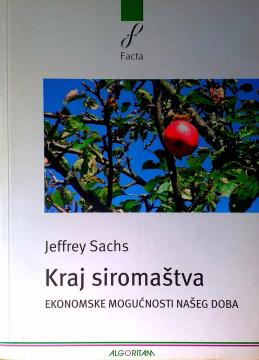
Kraj siromaštva: Ekonomske mogućnosti našeg doba

Kraj siromaštva: Ekonomske mogućnosti našeg doba

Jeffrey Sachs

In the book, economist Jeffrey Sachs presents an optimistic plan for eliminating extreme poverty by 2025. He argues that this is feasible with political will, because world wealth is growing, and poverty is not fate, but the result of inefficient systems.

Sachs introduces "clinical economics" - a systematic approach to treating a disease: diagnosis of the problem, prescription (interventions), and monitoring. He focuses on the poorest countries in Africa, Asia, and Latin America, where billions of people live on less than $1 a day. Key causes: geographical barriers (tropical diseases, droughts), lack of investment in infrastructure, education, and health, and political instability.

He proposes a three-pronged plan: (1) Urgent aid for the "big fight" - networks for malaria prevention, AIDS, distribution of seeds and fertilizers for agriculture; (2) Long-term development - building roads, schools, clinics; (3) Global cooperation - increasing support from rich countries to 0.7% of GDP for development aid, debt cancellation, and non-discriminatory trade rules.

The book is replete with case studies: Sachs's success in Bolivia (1985, hyperinflation stopped), Poland (shock therapy), and Zambia (malaria controlled). He criticizes the West for ineffective aid and calls for support for the Millennium Development Goals of the UN. It concludes that poverty is not inevitable – with $175 billion a year (less than 1% of global GDP) we can save lives, prevent wars and boost growth.

Sachs's vision is inspiring, but critics warn of the risks of dependence on aid. Nevertheless, the book remains a manifesto of humanism in economics.

Original title
The End of Poverty: Economic Possibilities for Our Time
Translation
Nebojša Buđanovac
Editor
Irena Miličić
Dimensions
23 x 17 cm
Pages
450
Publisher
Algoritam, Zagreb, 2007.
 
Latin alphabet. Paperback.
Language: Croatian.

One copy is available

Condition:Used, excellent condition
 

Are you interested in another book? You can search the offer using our search engine or browse books by category.

You may also be interested in these titles

RAF: Frakcija Crvene Armije 1970-1998

RAF: Frakcija Crvene Armije 1970-1998

Pavle Kalinić

Pavle Kalinić's book is an authoritative account of... the period... in which the German Red Army Faction was created and operated.

Profil International, 2002.
Croatian. Latin alphabet. Paperback.
5.844.09
Povijest Hrvatske 1945-2011. (2.svezak)

Povijest Hrvatske 1945-2011. (2.svezak)

Ivo Goldstein

Goldstein's "History of Croatia" is one of the most reliable books published in the past period, especially rich in historical works.

EPH media d. o. o., 2011.
Croatian. Latin alphabet. Paperback.
5.224.18
Špijun kojeg smo voljeli: Autobiografija

Špijun kojeg smo voljeli: Autobiografija

Stevan Dedijer

This posthumous autobiography, prepared by his wife Carin and son Miki, is not just a memoir; it is a whirlwind of anecdotes about freedom and politics, where brother Vladimir fights for the partisans, and Stevan joins the American ranks of the OSS (forer

V.B.Z, 2011.
Croatian. Latin alphabet. Paperback.
8.36
Jedna planeta je opljačkana : zastrašujući bilans jedne politike

Jedna planeta je opljačkana : zastrašujući bilans jedne politike

Herbert Grul

The book was published in September 1975 by the then CDU representative in the Bundestag, Herbert Gruhl. After the Club of Rome showed the "limits to growth" on our planet, Gruhl raised the question in this book about the remaining possibilities of our ec

Prosveta, 1985.
Serbian. Latin alphabet. Paperback.
5.98 - 5.99
Sudbonosni podvig Jugoslavije: Podsjećanje na historijsko NE staljinizmu, događaj koji je opredijelio budućnost Jugoslavije

Sudbonosni podvig Jugoslavije: Podsjećanje na historijsko NE staljinizmu, događaj koji je opredijelio budućnost Jugoslavije

Raif Dizdarević

The book by Raif Dizdarević, one of the last living actors of Yugoslav diplomacy, presents his reconstruction of the most fateful moment of post-war Yugoslavia – the split with Stalin and the Informburo in 1948–1953.

Udruženje za modernu historiju (UMHIS), 2018.
Croatian. Latin alphabet. Paperback.
23.58
Zakon vrijednosti u staljinističkoj koncepciji

Zakon vrijednosti u staljinističkoj koncepciji

Dušan Dragosavac

Dragosavac first explains what the law of value is according to Karl Marx – the fundamental economic law of commodity production in which the exchange of goods depends on socially necessary working time.

Narodno sveučilište, 1976.
Croatian. Latin alphabet. Paperback with dust jacket.
7.98