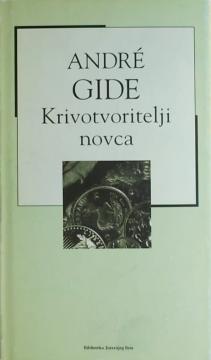
Krivotvoritelji novca

Krivotvoritelji novca

Andre Gide

The Counterfeiters (1925) is an intellectually challenging novel, appreciated for its philosophical depth and courage. Written as an experimental "novel within a novel", Gide breaks with traditional narrative, offering a multi-layered reflection on authen

The plot follows several adolescents and adults whose lives intertwine. Bernard Profitendieu, a rebellious young man, discovers that he is not his father's son and leaves home, searching for his own identity. His friend Olivier Molinier struggles with family expectations and his attraction to an older writer, Édouard, who is writing a novel of the same title, The Counterfeiters of Money, creating a metanarrative. Édouard's quest for pure art mirrors Gide's own struggle with creativity, while characters like Bernard and Olivier test the limits of morality, sexuality, and freedom.

The novel explores "counterfeiting" in a metaphorical sense—false morality, social norms, and artistic compromise—as the characters struggle to find authenticity in a world full of deception. Gide uses diary entries, letters, and dialogue, creating a fragmented structure that reflects the chaos of youth and intellectual pursuits. Gide's style, imbued with irony and psychological acumen, makes it a key work of modernism, inviting readers to question truth and freedom.

Original title
Les faux-monnayeurs
Translation
Dane Smičiklas
Dimensions
21 x 12.5 cm
Pages
350
Publisher
Jutarnji list, Zagreb, 2004.
 
Latin alphabet. Hardcover with dust jacket.
Language: Croatian.
ISBN
978-9-53716-017-3

Multiple copies are available

Copy number 1

Condition:Unused

Copy number 2

Condition:Used, excellent condition

Copy number 3

Condition:Used, excellent condition

Copy number 4

Condition:Unused
 

Are you interested in another book? You can search the offer using our search engine or browse books by category.

You may also be interested in these titles

Proces

Proces

Franz Kafka

Kafka wrote The Process between 1914 and 1915, published posthumously in 1925. The novel is unfinished but with an added final chapter by Max Brod. Edition with a foreword by B. Živojinović and an afterword by Walter Killi.

BIGZ, 1990.
Serbian. Latin alphabet. Paperback.
4.26
Andrićeva lestvica užasa

Andrićeva lestvica užasa

Svetislav Basara

A Serbian writer known for his satirical novels, Andrić's Ladder of Horrors dissects the Balkan mentality through a parable of Yugo-nostalgia and national myths. The title alludes to Ivo Andrić as a litmus test for criticism – Balkans claim him or reject

24 sata, 2021.
Serbian. Latin alphabet. Paperback.
11.56
Usta puna zemlje

Usta puna zemlje

Branimir Šćepanović

The novel "Usta puna zemlje" (1970), the masterpiece of the Serbian writer Branimir Šćepanović, is a psychologically in-depth explorer of the limits of the human soul, solitude and existential freedom, reminiscent of Kafka and Camus.

BIGZ, 1987.
Serbian. Latin alphabet. Paperback.
3.98
Đavoli dolaze

Đavoli dolaze

Miodrag Bulatović
Rad, 1986.
Serbian. Latin alphabet. Paperback.
1.16
Kad žena zri

Kad žena zri

Honore de Balzac
Svjetlost, 1970.
Croatian. Latin alphabet. Hardcover.
4.99 - 5.00
Čovjek s dva lica

Čovjek s dva lica

Lee Child

Released in 2003, "The Man with Two Faces" is the second installment in the rich thriller series by author Lee Child.

Znanje, 2010.
Croatian. Latin alphabet. Paperback.
8.42