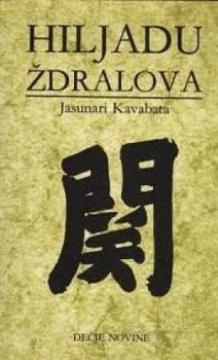
Hiljadu ždralova

Hiljadu ždralova

Jasunari Kavabata

The tea ceremony, arranging flowers, arranging gardens and the art of creating beautiful porcelain stand in the background of this novel as symbols of the eternal and timeless in human creativity.

Human feelings, in contrast to artistic creativity, are shown as momentary, fragile, changeable and transitory. In this contrast between man and art, Kawabata wove the subtle and delicate plot of the novel. The main character, Kikudi, is a victim of his childhood memories and fails to occupy a certain position in reality. After the death of his father and mother, he is looking for fresh and pure love, but he cannot get rid of the dark memories from his childhood. Then he falls fatally in love with his father's former lover, Mrs. Ota, who represents a bridge between the past and the present. Overwhelmed by remorse and guilt, Mrs. Ota commits suicide. After her death, Kikudi cannot get rid of his longing for the deceased, but gradually his love for his mother is transferred to her daughter Fumiko. The end of the novel is uncertain because Fumiko is also overcome with guilt and cannot openly accept Kikudi's love.

Titel des Originals
Sembazuru
Übersetzung
Dejan Razić
Editor
Ljiljana Novaković
Maße
20 x 12,5 cm
Seitenzahl
139
Verlag
Dečje novine, Gornji Milanovac, 1989.
 
Auflage: 3.000 Exemplare
 
Latein Schrift. Taschenbuch.
Sprache: Kroatisch.

Angeboten wird ein Exemplar

Zustand:Gebraucht, in sehr gutem Zustand
Nachteile/Unannehmlichkeiten:
  • Slight damage to the cover
Zum Warenkorb hinzugefügt!
 

Interessieren Sie sich für ein anderes Buch? Sie können das Angebot über unsere Suchmaschine suchen und finden oder Bücher nach Kategorien durchsuchen.

Diese Titel könnten Sie auch interessieren

Deobe 1-3

Deobe 1-3

Dobrica Ćosić

This work, awarded the NIN Prize for that year, is considered one of the most significant in Serbian literature after World War II.

Prosveta, 1961.
Serbisch. Kyrillisch Schrift. Fester Einband mit Schutzumschlag.
Das Buch besteht aus drei Bänden
11,42
Stotina godina (antikronika)

Stotina godina (antikronika)

Dario Harjaček

The novel One Hundred Years by Dario Harjaček provides a panoramic view of Trešnjevka and its inhabitants through a century of changes, ideologies, and human destinies – a mosaic of Zagreb in which life, art, and history intertwine.

Oceanmore, 2025.
Kroatisch. Latein Schrift. Taschenbuch.
13,42
Posljednji harem

Posljednji harem

Peter Prange

If you love One Thousand and One Nights with a historical twist, this is a sensual harem saga – rich, emotional, irresistible! An epic novel about the end of the Ottoman Empire, harem intrigue, and the birth of modern Turkey.

Naklada Ljevak, 2010.
Kroatisch. Latein Schrift. Taschenbuch.
11,26
Dok ležah na samrti

Dok ležah na samrti

William Faulkner

Faulkner's 1930 novel, a classic example of modernist literature. It is often compared to Joyce's "Ulysses" for its innovative structure, but is more accessible due to its focus on family.

Rad, 1985.
Kroatisch. Latein Schrift. Taschenbuch.
3,26
Knjiga moga oca

Knjiga moga oca

Ethem Mandić

This is a biography about my father made up of memories and mere imagination. History does not exist, and neither do facts. The past is unknown.

OKF d.o.o, 2016.
Kroatisch. Latein Schrift. Taschenbuch.
10,64
Crna kutija

Crna kutija

Amos Oz

The Black Box is a kaleidoscope of married life and love relationships. It is a novel that implicitly speaks about all of us.

Hena Com, 2001.
Kroatisch. Latein Schrift. Hardcover.
10,98