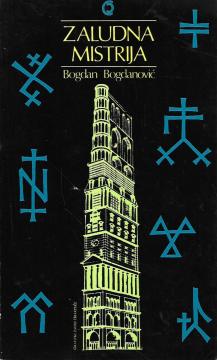
Zaludna mistrija: doktrina i praktična bratstva zlatnih (crnih) brojeva

Zaludna mistrija: doktrina i praktična bratstva zlatnih (crnih) brojeva

Bogdan Bogdanović

A collection of essays, autobiographical records, diary fragments and thought structures of Bogdan Bogdanović - architect, former mayor of Belgrade, university professor, and one of the most original intellectuals of the Yugoslav cultural circle.

The book was written during his kind of internal exile during the period of nationalist erosion in the 1980s and 1990s in Yugoslavia, and it particularly highlights his resistance to ideological, political and aesthetic banality.

The titular "trowel" (a trowel for applying plaster) serves as a symbol of Freemasonry and construction, but here it is "vain" – it refers to a feeling of powerlessness in a time when true builders of the spirit are marginalized. Throughout the book it is clear that the author, although not explicitly, uses Masonic, Hermetic and symbolic motifs to build his own, allegorical view of the world. Bogdanović is known for his deep interest in esotericism, mythology, symbolism and language as a building material – both architectural and intellectual.

The book is full of symbols from Freemasonry – pyramids, labyrinths, measuring instruments, tools, metaphors of light, secret letters, “ghost cities”. He speaks of the city as a symbol, not just a spatial entity, and of the monument as a “mysterious architecture” – a space dedicated to memory and silence. At the heart of it all is myth as a language of understanding reality, in contrast to the banal utilitarianism of modern politics and urbanism.

Bogdanović pays special attention to Freemasonry as a spiritual heritage of builders, without ever explicitly claiming to be a member of it. However, his constant use of symbolic language, the thematization of secret knowledge, as well as his interest in Hermeticism, allegory, Gnosticism and the Kabbalistic structure of language, testify to a deep connection with the Masonic spiritual tradition – either directly or through cultural and philosophical influence.

In the context of ubiquitous political repression and the destruction of meaning, Bogdanović's "futile trowel" becomes an act of resistance – in writing, he "builds" what cannot be destroyed by tanks and slogans: the language of meaning, symbolism and inner freedom.

Titelseite
Sanja Iveković
Maße
22 x 14 cm
Seitenzahl
179
Verlag
Grafički zavod Hrvatske (GZH), Zagreb, 1984.
 
Latein Schrift. Taschenbuch.
Sprache: Serbisch.

Im Angebot sind keine Exemplare vorhanden

Das letzte Exemplar wurde kürzlich verkauft.
 

Interessieren Sie sich für ein anderes Buch? Sie können das Angebot über unsere Suchmaschine suchen und finden oder Bücher nach Kategorien durchsuchen.

Diese Titel könnten Sie auch interessieren

Pismo nerođenom djetetu

Pismo nerođenom djetetu

Oriana Fallaci

One of the most moving and courageous works of world literature of the 20th century. Written as a long monologue by a pregnant woman (Fallaci herself), the book is at once an intimate confession, a feminist manifesto, and a philosophical confrontation wit

Znanje, 2009.
Kroatisch. Latein Schrift. Taschenbuch.
4,56
I drugi su pjevali o ratu: Odjeci raspada Jugoslavije u engleskoj i američkoj književnosti

I drugi su pjevali o ratu: Odjeci raspada Jugoslavije u engleskoj i američkoj književnosti

Muharem Bazdulj

In this book of essays, Muharem Bazdulj analyzes how the collapse of Yugoslavia and the wars of the 1990s resonated in Anglo-Saxon literature – from pre-war stereotypes to war and post-war depictions.

Biblioteka XX vek, 2013.
Kroatisch. Latein Schrift. Taschenbuch.
8,24
Objektivni korelativi: tuga - mržnja - radost

Objektivni korelativi: tuga - mržnja - radost

Dalibor Cvitan

A posthumous collection published on the occasion of the 25th anniversary of the death of Dalibor Cvitan (1934–1993), a prose writer, poet, essayist and critic. It contains a selection of around twenty essays, short stories and feuilletons - a cross-secti

Društvo hrvatskih književnika, 2018.
Kroatisch. Latein Schrift. Taschenbuch.
6,32
Dunav: P.S. 1991. vukovarske razglednice

Dunav: P.S. 1991. vukovarske razglednice

Pavao Pavličić

A moving and poignant chronicle of the siege and destruction of Vukovar in 1991 through 57 short "postcard" chapters. Pavličić does not write from the perspective of an "ordinary" Zagreb resident who spent the summer of 1991 in Vukovar, and then followed

Hena Com, 1999.
Kroatisch. Latein Schrift. Hardcover.
11,26
Dnevnici, 2. svezak: 1912-1914.

Dnevnici, 2. svezak: 1912-1914.

Franz Kafka

The second volume of Kafka's diaries covers the crucial years 1912–1914. This volume is a bridge between the early sketches and the mature novels, and the fragments are raw, aphoristic, full of self-mutilation, but also ingenious introspection.

Tim press, 2022.
Kroatisch. Latein Schrift. Taschenbuch.
16,34
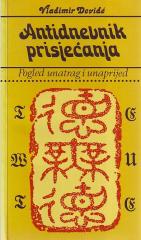
Antidnevnik prisjećanja: Pogled unatrag i unaprijed

Antidnevnik prisjećanja: Pogled unatrag i unaprijed

Vladimir Devidé

Vladimir Devidé, a Croatian mathematician, Japanologist and essayist, creates an intimate, fragmentary autobiography in Anti-Diary of Recollections through around twenty texts – essays, stories, humorous and satirical articles, travelogues, reflections an

Znanje, 1995.
Kroatisch. Latein Schrift. Taschenbuch.
11,26