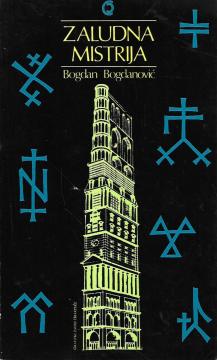
Zaludna mistrija: doktrina i praktična bratstva zlatnih (crnih) brojeva

Zaludna mistrija: doktrina i praktična bratstva zlatnih (crnih) brojeva

Bogdan Bogdanović

A collection of essays, autobiographical records, diary fragments and thought structures of Bogdan Bogdanović - architect, former mayor of Belgrade, university professor, and one of the most original intellectuals of the Yugoslav cultural circle.

The book was written during his kind of internal exile during the period of nationalist erosion in the 1980s and 1990s in Yugoslavia, and it particularly highlights his resistance to ideological, political and aesthetic banality.

The titular "trowel" (a trowel for applying plaster) serves as a symbol of Freemasonry and construction, but here it is "vain" – it refers to a feeling of powerlessness in a time when true builders of the spirit are marginalized. Throughout the book it is clear that the author, although not explicitly, uses Masonic, Hermetic and symbolic motifs to build his own, allegorical view of the world. Bogdanović is known for his deep interest in esotericism, mythology, symbolism and language as a building material – both architectural and intellectual.

The book is full of symbols from Freemasonry – pyramids, labyrinths, measuring instruments, tools, metaphors of light, secret letters, “ghost cities”. He speaks of the city as a symbol, not just a spatial entity, and of the monument as a “mysterious architecture” – a space dedicated to memory and silence. At the heart of it all is myth as a language of understanding reality, in contrast to the banal utilitarianism of modern politics and urbanism.

Bogdanović pays special attention to Freemasonry as a spiritual heritage of builders, without ever explicitly claiming to be a member of it. However, his constant use of symbolic language, the thematization of secret knowledge, as well as his interest in Hermeticism, allegory, Gnosticism and the Kabbalistic structure of language, testify to a deep connection with the Masonic spiritual tradition – either directly or through cultural and philosophical influence.

In the context of ubiquitous political repression and the destruction of meaning, Bogdanović's "futile trowel" becomes an act of resistance – in writing, he "builds" what cannot be destroyed by tanks and slogans: the language of meaning, symbolism and inner freedom.

Naslovnica
Sanja Iveković
Dimenzije
22 x 14 cm
Broj strana
179
Nakladnik
Grafički zavod Hrvatske (GZH), Zagreb, 1984.
 
Latinica. Broširano.
Jezik: Srpski.

Nema primjeraka u ponudi

Poslednji primjerak je nedavno prodan.
 

Zanima Vas i neka druga knjiga? Možete pretražiti našu ponudu pomoću tražilice ili prelistati knjige po kategorijama.

Možda će Vas zanimati i ovi naslovi

Historijska čitanka 2

Historijska čitanka 2

Miljenko Jergović

The first edition of the second part of the series with 5 new (bonus) stories by a famous writer and journalist. "This book completes the 'Historical Reader', a project - a column started on the pages of the Sarajevo magazine Dani, shortly after the end o

Durieux, 2004.
Hrvatski. Latinica. Tvrde korice.
7,32
Pismo nerođenom djetetu

Pismo nerođenom djetetu

Oriana Fallaci

One of the most moving and courageous works of world literature of the 20th century. Written as a long monologue by a pregnant woman (Fallaci herself), the book is at once an intimate confession, a feminist manifesto, and a philosophical confrontation wit

Znanje, 2009.
Hrvatski. Latinica. Broširano.
4,56
Antidnevnik prisjećanja: Pogled unatrag i unaprijed

Antidnevnik prisjećanja: Pogled unatrag i unaprijed

Vladimir Devidé

Vladimir Devidé, a Croatian mathematician, Japanologist and essayist, creates an intimate, fragmentary autobiography in Anti-Diary of Recollections through around twenty texts – essays, stories, humorous and satirical articles, travelogues, reflections an

Znanje, 1995.
Hrvatski. Latinica. Broširano.
11,26
Sizifova sreća - razgovori, kronike

Sizifova sreća - razgovori, kronike

Ivan Lovrenović

Ivan Lovrenović's collection documents thirty years of change in Bosnia and Herzegovina through interviews, essays, and dialogues. The author, a witness to the era, examines old attitudes in the new reality, emphasizing the atrophy of rationality and soci

Synopsis, 2018.
Hrvatski. Latinica. Broširano.
12,5410,03
Tu nema ničega!

Tu nema ničega!

Dubravka Ugrešić

In her provocative essay, Dubravka Ugrešić considers life in post-socialist Europe and Croatia using the example of spas.

Multimedijalni institut, 2020.
Hrvatski. Latinica. Broširano.
13,58
Imenik lijepih vještina I-II

Imenik lijepih vještina I-II

Miljenko Jergović

U „Imeniku likovnih umetnosti“, Miljenko Jergović istražuje raznovrsne teme, od književnosti do istorije, slaveći umetnost i izvrsnost. Njegovi eseji nude duboko razumevanje, prožeti intelektualnom strašću i ljubavlju prema pisanoj reči.

24 sata, 2018.
Hrvatski. Latinica. Tvrde korice s ovitkom.
Knjiga se sastoji od dva toma
34,56