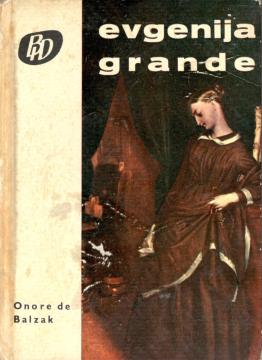
Evgenija Grande / Muzej starina

Evgenija Grande / Muzej starina

Honore de Balzac

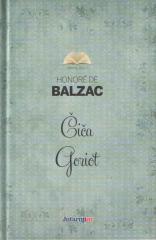
In his novels Eugenie Grandet (1833) and The Museum of Antiquities (1837), Balzac explores universal themes of greed, human passions, sacrifice, and moral dilemmas, placing them in different social contexts of 19th-century French society.

  • Eugène Grande: A novel from The Human Comedy (1833) is set in Saumur, where the miserly Félix Grande, a wealthy merchant, controls his family – his wife and daughter Eugène. His obsession with money stifles all joy. Eugène, young and innocent, falls in love with her cousin Charles, a spoiled Parisian who arrives after her father's bankruptcy and suicide. She gives him her gold so that he can start a new life in India, waiting for him faithfully. Félix dies, leaving Eugène a fortune, but Charles betrays her, choosing a marriage of convenience. Heartbroken, Eugène marries Judge Cruchot, who soon dies. As a wealthy widow, she lives a solitary life, dedicated to charity. Balzac explores greed, sacrifice, and the tragic power of unrequited love.

  • "The Museum of Antiquities" (1837), part of Balzac's Human Comedy, is set in the provincial town of Alençon and Paris, where the fates of the aristocracy and the bourgeoisie intertwine. The story follows the young Victurnien d'Esgrignon, a nobleman from an old family, whose extravagance and gambling debts threaten the family's honor. His aunt, Armande, and father try to save him, but Victurnien falls into a web of manipulation by Chesnel, a loyal servant, and Du Croisier, a cunning bourgeois who wants to destroy d'Esgrignone. The plot is complicated when Victurnien steals money, and his love affair with a Parisian noblewoman further drags him into ruin. Balzac explores the conflict between the decadent aristocracy and the ambitious bourgeoisie, depicting moral corruption, social intrigue, and the decline of the old order. The novel is a satire of society and a character study, emphasizing the powerlessness of tradition in the face of the new capitalist world.

Naslov originala
Eugenie Grandet / Le cabinet des antiques
Prevod
Dušan Đokić, Ilija Kecmanović
Urednik
Milica Grabovac
Dimenzije
16,5 x 12 cm
Broj strana
352
Izdavač
Svjetlost, Sarajevo, 1963.
 
Latinica. Tvrde korice.
Jezik: Hrvatski.

Jedan primerak je u ponudi

Stanje:Korišćeno, u odličnom stanju
Oštećenja / nepogodnosti:
  • Traces of patina
Dodato u korpu!
 

Zanima Vas i neka druga knjiga? Možete pretražiti našu ponudu pomoću pretrage ili prelistati knjige po kategorijama.

Možda će Vas zanimati i ovi naslovi

Čiča Goriot

Čiča Goriot

Honore de Balzac

Čiča Goriot je priča o starome ratnom profiteru Goriotu i njegovim kćerima, koje ga, nakon što su ga opljačkale do gole kože, ostavljaju da umre u samoći i bijedi pansiona Vaquer, priča je koja se danas može čitati na nekoliko razina.

Europapress holding, 2008.
Hrvatski. Latinica. Tvrde korice.
6,32 - 6,99
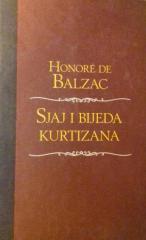
Sjaj i bijeda kurtizana

Sjaj i bijeda kurtizana

Honore de Balzac

The Splendor and Misery of a Courtesan is part of Balzac's collection The Human Comedy. The novel follows the fate of Lucien de Rubempré, an ambitious young poet, and his relationship with the mysterious Vautrin, an ex-convict, in the world of Parisian de

Globus, 2004.
Hrvatski. Latinica. Tvrde korice.
4,76 - 4,82
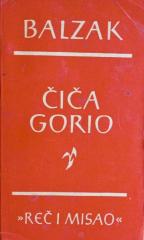
Čiča Gorio

Čiča Gorio

Honore de Balzac

Onkel Goriot ist die Geschichte des alten Kriegsgewinnlers Goriot und seiner Töchter, die ihn, nachdem sie ihn bis auf die Haut ausgeraubt haben, in der Einsamkeit und dem Elend der Vaquer-Pension sterben lassen, eine Geschichte, die heute auf mehreren Eb

Rad, 1961.
Srpski. Latinica. Broširano.
1,99
Stotina godina (antikronika)

Stotina godina (antikronika)

Dario Harjaček

The novel One Hundred Years by Dario Harjaček provides a panoramic view of Trešnjevka and its inhabitants through a century of changes, ideologies, and human destinies – a mosaic of Zagreb in which life, art, and history intertwine.

Oceanmore, 2025.
Hrvatski. Latinica. Broširano.
13,42
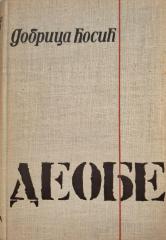
Deobe 1-3

Deobe 1-3

Dobrica Ćosić

Dieses Werk, das in diesem Jahr mit dem NIN-Preis ausgezeichnet wurde, gilt als eines der bedeutendsten der serbischen Literatur nach dem Zweiten Weltkrieg.

Prosveta, 1961.
Srpski. Ćirilica. Tvrde korice s omotom.
Knjiga se sastoji od tri toma
11,42
Proces

Proces

Franz Kafka

Kafka schrieb „Der Prozess“ zwischen 1914 und 1915 und veröffentlichte es posthum im Jahr 1925. Der Roman ist unvollendet, wurde aber um ein letztes Kapitel von Max Brod ergänzt. Ausgabe mit einem Vorwort von B. Živojinović und einem Nachwort von Walter K

BIGZ, 1990.
Srpski. Latinica. Broširano.
4,26