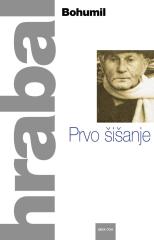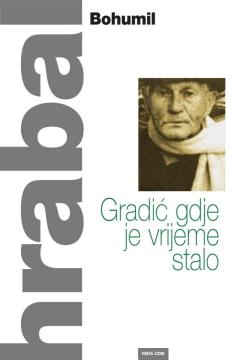
Gradić gdje je vrijeme stalo

Gradić gdje je vrijeme stalo

Bohumil Hrabal

Bohumil Hrabal, a Czech writer known for his lyrical grotesque and humor, in his novel The Town Where Time Stood Still evokes childhood in the small town of Libeň (part of Prague), where time seems to stand still in a magical but melancholic world.

The narrator, the writer's alter ego, recalls the 1920s: his father's brewery, his mother's love of animals, street adventures and family secrets, where everyday life turns into a fairy tale full of wonder and sadness.

The novel is a series of fragmentary images: a boy plays in the brewery gardens, watches the royal train, meets eccentric characters such as a kneeling uncle or a grandmother who tells the story. The time that has "stood still" symbolizes the lost idyll in the face of industrialization and wars - the small town is a microcosm of Europe, where Czech tradition, Jewish culture and German influences mix. Hrabal's style - stream of consciousness, hyperbole, love of detail - creates a poetic symphony: laughter provokes tears, and nostalgia bites the heart.

The themes are the transience of childhood, the power of the story, the conflict of idyll and reality. As part of Hrabal's "autobiographical" cycle (First Haircut, Long Live Yugoslavia), the novel celebrates life as a "small town" in the soul, where time does not stop, but is transformed into art. A masterpiece for lovers of Czech prose, it reminds us: "Life is a dream, and a dream is eternity."

Titel des Originals
Mastecko, kde se zastavil čas
Übersetzung
Sanja Milićević Armada
Editor
Nermina Husković
Maße
21,5 x 14 cm
Seitenzahl
151
Verlag
Hena Com, Zagreb, 2006.
 
Latein Schrift. Taschenbuch.
Sprache: Kroatisch.
ISBN
978-9-53259-004-3

Angeboten wird ein Exemplar

Zustand:Gebraucht, in ausgezeichnetem Zustand
Zum Warenkorb hinzugefügt!
 

Interessieren Sie sich für ein anderes Buch? Sie können das Angebot über unsere Suchmaschine suchen und finden oder Bücher nach Kategorien durchsuchen.

Diese Titel könnten Sie auch interessieren

Prebučna samoća

Prebučna samoća

Bohumil Hrabal

Loud Loneliness (1976), a novel by Bohumil Hrabal, is an introspective monologue by Hant'a, an old worker at a paper collection center in Prague, who has been pressing waste paper and books into packages with a hydraulic press for 35 years, calling it his

Hena Com, 2004.
Kroatisch. Latein Schrift. Taschenbuch.
7,24
Prvo šišanje

Prvo šišanje

Bohumil Hrabal

The First Haircut, a short story written in 1970 and published in 1976, is the first in a series of prose pieces by Bohumil Hrabal describing Nymburk, the town where he spent his childhood. In 1981, The First Haircut was adapted for the screen by Jiry Men

24 sata, 2007.
Kroatisch. Latein Schrift. Taschenbuch.
7,245,43
Figarova ženidba ili Ludi dan: Komedija u pet ćinova

Figarova ženidba ili Ludi dan: Komedija u pet ćinova

Pierre-Augustin Caron de Beaumarchais

The comedy "The Marriage of Figaro, or The Mad Day" (1784) is a sequel to The Barber of Seville. The Marriage of Figaro criticizes social injustices through love affairs and intrigue, celebrating Figaro and Susanna's ingenuity in the fight against aristoc

Srpska književna zadruga (SKZ), 1925.
Serbisch. Kyrillisch Schrift. Hardcover.
7,58
Grafiti & co

Grafiti & co

Vedran Vrsalović

500+ graffiti

Grafiti & co, 2006.
Kroatisch. Latein Schrift. Taschenbuch.
4,98
Muka s rečima

Muka s rečima

Milovan Danojlić
Biblioteka XX vek, 1990.
Kroatisch. Latein Schrift. Taschenbuch.
3,54
Kradljivac vrhova

Kradljivac vrhova

Radek Knapp

The thief of the peaks is a book with a dose of the finest philosophical-Lacrdian humor that can be read as a guide to solving small and large life puzzles.

Sipar, 2019.
Kroatisch. Latein Schrift. Taschenbuch.
7,92 - 7,94