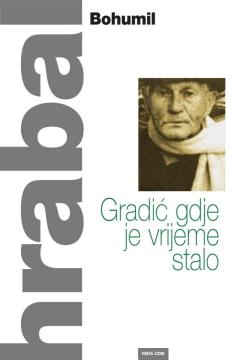
Gradić gdje je vrijeme stalo

Gradić gdje je vrijeme stalo

Bohumil Hrabal

Bohumil Hrabal, a Czech writer known for his lyrical grotesque and humor, in his novel The Town Where Time Stood Still evokes childhood in the small town of Libeň (part of Prague), where time seems to stand still in a magical but melancholic world.

The narrator, the writer's alter ego, recalls the 1920s: his father's brewery, his mother's love of animals, street adventures and family secrets, where everyday life turns into a fairy tale full of wonder and sadness.

The novel is a series of fragmentary images: a boy plays in the brewery gardens, watches the royal train, meets eccentric characters such as a kneeling uncle or a grandmother who tells the story. The time that has "stood still" symbolizes the lost idyll in the face of industrialization and wars - the small town is a microcosm of Europe, where Czech tradition, Jewish culture and German influences mix. Hrabal's style - stream of consciousness, hyperbole, love of detail - creates a poetic symphony: laughter provokes tears, and nostalgia bites the heart.

The themes are the transience of childhood, the power of the story, the conflict of idyll and reality. As part of Hrabal's "autobiographical" cycle (First Haircut, Long Live Yugoslavia), the novel celebrates life as a "small town" in the soul, where time does not stop, but is transformed into art. A masterpiece for lovers of Czech prose, it reminds us: "Life is a dream, and a dream is eternity."

Naslov originala
Mastecko, kde se zastavil čas
Prevod
Sanja Milićević Armada
Urednik
Nermina Husković
Dimenzije
21,5 x 14 cm
Broj strana
151
Izdavač
Hena Com, Zagreb, 2006.
 
Latinica. Broširano.
Jezik: Hrvatski.
ISBN
978-9-53259-004-3

Jedan primerak je u ponudi

Stanje:Korišćeno, u odličnom stanju
Dodato u korpu!
 

Zanima Vas i neka druga knjiga? Možete pretražiti našu ponudu pomoću pretrage ili prelistati knjige po kategorijama.

Možda će Vas zanimati i ovi naslovi

Prebučna samoća

Prebučna samoća

Bohumil Hrabal

Loud Loneliness (1976), a novel by Bohumil Hrabal, is an introspective monologue by Hant'a, an old worker at a paper collection center in Prague, who has been pressing waste paper and books into packages with a hydraulic press for 35 years, calling it his

Hena Com, 2004.
Hrvatski. Latinica. Broširano.
7,24
Prvo šišanje

Prvo šišanje

Bohumil Hrabal

The First Haircut, a short story written in 1970 and published in 1976, is the first in a series of prose pieces by Bohumil Hrabal describing Nymburk, the town where he spent his childhood. In 1981, The First Haircut was adapted for the screen by Jiry Men

24 sata, 2007.
Hrvatski. Latinica. Broširano.
7,245,43
Samrtno proljeće

Samrtno proljeće

Lajos Zilahy

A young diplomat returns from Barcelona devastated by parting with his beloved wife. And yet, he soon meets a new love.

Bratstvo-Jedinstvo, 1977.
Srpski. Latinica. Tvrde korice.
5,28
Begunac

Begunac

Lajos Zilahy

Lajoš Zilahi, Hungarian writer, left a deep mark in literature. His book "The Fugitive" from 1977 is one of his best works.

Bratstvo-Jedinstvo, 1977.
Srpski. Latinica. Tvrde korice.
5,64
Tit Andronik

Tit Andronik

William Shakespeare

The first of Shakespeare's ten tragedies – the drama about Titus Andronicus – is set in the late Roman era.

Nakladni zavod Matice hrvatske, 1977.
Hrvatski. Latinica. Tvrde korice s omotom.
5,724,29
Uzorana ledina 1-2

Uzorana ledina 1-2

Mihail Šolohov

The novel is set in a Cossack community on the Don River during collectivization in the Soviet Union. The work, divided into two parts, follows the dramatic changes in the village of Gremyachi Log as the Bolsheviks introduce collective farms, which provok

Svjetlost, 1979.
Srpski. Latinica. Tvrde korice.
Knjiga se sastoji od dva toma
13,96