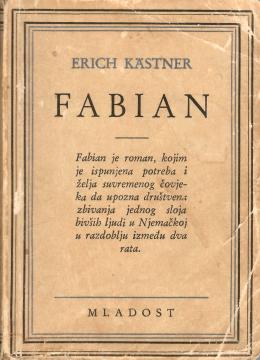
Fabian: Pripovijest o moralistu
Ein rares Buch

Fabian: Pripovijest o moralistu

Erich Kästner

Jakob Fabian, an unemployed Germanist and moralist, wanders through Berlin in the 1930s, observing the moral, political and social decay and the rise of Nazism. He falls in love with Cornelia, but tragedies and nonsense lead him to a tragic end. Criticism

The novel by Erich Kästner (1899–1974), author of children's classics such as Emil and the Detective and The Flying Class, Fabian is his most serious, darkest and most political work for adults. Published in 1931 in Stuttgart, the novel was immediately banned and burned by the Nazis in 1933 (Kästner was present at the burning of his own books). The first edition was censored (explicit erotic parts were removed); the full, uncensored version (Der Gang vor die Hunde) was only published posthumously in 2013, and earlier in some editions.

The protagonist Jakob Fabian (32 years old, doctor of German) works in an advertising agency, but loses his job in the midst of the economic crisis. A passive observer ("just watching"), he drifts through Berlin's nightlife: cabarets, brothels, alcohol, superficial relationships, political extremes (communists vs. Nazis). Fabian is an intellectual-moralist who believes in reason, decency and humanism, but he sees society falling apart - people are sold, values ​​disappear, politics becomes a circus. He falls in love with Cornelia Battenberg, an ambitious actress and intellectual, who gives him hope, but the relationship falls apart under the pressure of time. The key tragic event: the suicide of a friend of Labude (due to a false accusation of plagiarism), which Fabian perceives as a personal defeat. In the end, in a drunken state, Fabian drowns in the river – a senseless, helpless ending that symbolizes the fate of the liberal intelligentsia in the face of totalitarianism.

The novel is a mixture of satire, melancholy and sharp social criticism: it makes fun of the Berlin decadence of the "golden twenties" that turns into a nightmare, pornography as a metaphor for society, media manipulation, mass unemployment. Kästner uses short, crisp sentences, a documentary style, newspaper quotes and poems.

Titel des Originals
Fabian. Die Geschichte eines Moralisten
Übersetzung
Stanislav Šimić
Maße
15 x 10 cm
Seitenzahl
265
Verlag
Mladost, Zagreb, 1952.
 
Latein Schrift. Taschenbuch.
Sprache: Kroatisch.

Angeboten wird ein Exemplar

Zustand:Gebraucht, in ausgezeichnetem Zustand
Nachteile/Unannehmlichkeiten:
  • Blago oštećenje korica
Zum Warenkorb hinzugefügt!
 

Interessieren Sie sich für ein anderes Buch? Sie können das Angebot über unsere Suchmaschine suchen und finden oder Bücher nach Kategorien durchsuchen.

Diese Titel könnten Sie auch interessieren

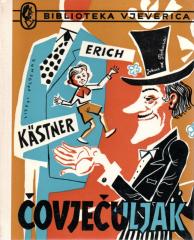
Čovječuljak

Čovječuljak

Erich Kästner
Mladost, 1976.
Kroatisch. Latein Schrift. Hardcover.
3,98 - 4,98
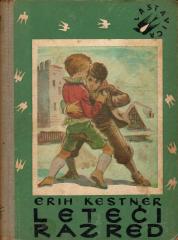
Leteći razred

Leteći razred

Erich Kästner

Mnogi ljudi svoje detinjstvo odbacuju kao stari šešir. Zaboravljaju ga kao telefonski broj koji više ne važi. U početku su takvi ljudi bili deca, zatim su postali odrasli, ali šta su oni zapravo? Samo onaj ko odraste i ostane čovek!

Narodna prosvjeta, 1959.
Kroatisch. Latein Schrift. Hardcover.
6,78
Proces

Proces

Franz Kafka

Kafka wrote The Process between 1914 and 1915, published posthumously in 1925. The novel is unfinished but with an added final chapter by Max Brod. Edition with a foreword by B. Živojinović and an afterword by Walter Killi.

BIGZ, 1990.
Serbisch. Latein Schrift. Taschenbuch.
4,26
U sjenci smrti

U sjenci smrti

Marie-Louise Fischer
Otokar Keršovani, 1983.
Kroatisch. Latein Schrift. Fester Einband mit Schutzumschlag.
2,36 - 4,99
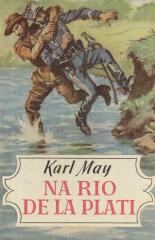
U Kordiljerima

U Kordiljerima

Karl May

In the Cordilleras (1894) is an adventure novel, a sequel to On the Rio de la Plata, part of May's South American cycle. The book follows adventures in Argentina during the revolutions, emphasizing themes of justice, forgiveness, and the struggle with the

Stvarnost, 1966.
Kroatisch. Latein Schrift. Hardcover.
4,52 - 7,32
Vergilijeva smrt

Vergilijeva smrt

Hermann Broch

The Death of Virgil (1945) is Hermann Broch's most famous work. The novel follows the final days of the Roman poet Publius Virgilius Marus, who, gravely ill, travels from Athens to Brundisium, arriving on the birthday of Emperor Augustus in 19 AD.

Svjetlost, 1982.
Kroatisch. Latein Schrift. Hardcover.
6,99