Koriensko pisanje
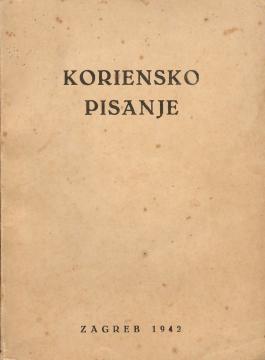
Das Koriensko pisavanje (1942) von Bratoljub Klaić ist ein vorläufiges Rechtschreibhandbuch des kroatischen Staatsamtes für die Sprache des Unabhängigen Staates Kroatien. Es propagiert die etymologische (morphologische) Rechtschreibung anstelle der phonet
Koriensko pisavanje ist eine Broschüre, die 1942 in zwei Auflagen von Adolf Bratoljub Klaić in Zusammenarbeit mit Mitarbeitern des Kroatischen Staatssprachenamtes erstellt wurde. Sie erschien in Zagreb als vorläufiges Rechtschreibhandbuch gemäß der Rechtsverordnung von 1941 über die kroatische Sprache, ihre Reinheit und Rechtschreibung.
Die Broschüre besteht aus einem Vorwort, einem Teil mit den wichtigsten Rechtsvorschriften und Verordnungen zur Sprache sowie einem orthografischen Teil mit Regeln und einem Rechtschreibwörterbuch. Im Vorwort betont Klaić, dass Koriensko pisavanje keine Neuerung, sondern eine Fortführung der alten kroatischen Tradition der etymologischen Rechtschreibung darstellt.
Das Grundprinzip ist morphologisch-etymologisch: Die Schreibweise richtet sich nach dem Ursprung (der Wurzel) des Wortes und nicht nach seiner Aussprache. Dies bedeutet, dass Konsonanten nicht durch Sonorität angeglichen werden (z. B. vrabci, dohodka, svatba, ekačba, glasba, zubčanik, potrebština statt phonetischer Formen), die Konsonanten d und t in verschiedenen Gruppen erhalten bleiben (srdce, otca, sudca, gostba, chastnik, bolestnik), n vor b/p nicht zu m wird (jedanput, nastanba) usw. Die Schreibung der Diphthonge ie/je ist speziell geregelt (nach dem Jat-Reflex: diète, cviet, rieč, aber djete, cvjetovi). Regeln für Fremdwörter (z. B. ohne das eingefügte j in material, dialog usw.) und die Silbentrennung von Wörtern sind ebenfalls vorgeschrieben.
Dies war ein Übergangsschritt hin zu einer umfassenderen Kroatischen Rechtschreibung (1944, Klaić und Franjo Cipra). Das Werk spiegelte die Sprachpolitik der NDH wider, die auf die Reinigung der Sprache und die Betonung ihrer Originalität durch einen traditionellen Wurzelansatz abzielte, im Gegensatz zur phonetischen Rechtschreibung, die in früheren Epochen vorherrschte. Heute gilt es als wichtige historische Quelle für die Erforschung der kroatischen Rechtschreibtradition und Sprachpolitik des 20. Jahrhunderts.
Die Broschüre ist selten, in Antiquariaten und digitalen Archiven erhältlich und stellt einen bedeutenden Teil des Werks von Bratoljub Klaić dar, der vor allem für sein späteres Wörterbuch der Fremdwörter bekannt ist.
Angeboten wird ein Exemplar