Koriensko pisanje
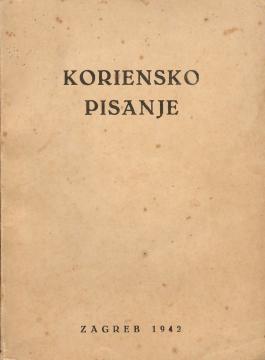
Koriensko pisavanje (1942) by Bratoljub Klaić is a temporary spelling manual of the Croatian State Office for the Language of the Independent State of Croatia. It promotes etymological-root (morphological) spelling instead of phonetic spelling.
Koriensko pisavanje is a booklet prepared in 1942, in two editions, by Adolf Bratoljub Klaić with the cooperation of members of the Croatian State Language Office. It was published in Zagreb as a temporary spelling manual in accordance with the 1941 Legal Provision on the Croatian Language, its Purity and Spelling.
The booklet consists of a preface, a legislative part (which publishes key legal provisions and orders on the language), and an orthographic part with rules and a spelling dictionary. In the preface, Klaić emphasizes that koriensko pisavanje is not a novelty, but a continuation of the old Croatian tradition of etymological spelling.
The fundamental principle is morphological-etymological: it is written according to the origin (root) of the word, and not according to its pronunciation. This means that consonants are not equalized by sonority (e.g. vrabci, dohodka, svatba, ekačba, glasba, zubčanik, potrebština instead of phonetic forms), the consonants d and t are preserved in various sets (srdce, otca, sudca, gostba, chastnik, bolestnik), n is not changed to m before b/p (jedanput, nastanba), etc. The writing of diphthongs ie/je is specially regulated (according to the Jat reflex: diète, cviet, rieč, but djete, cvjetovi). Rules for foreign words (e.g. without the inserted j in material, dialog, etc.) and the division of words into syllables are also prescribed.
This was a transitional step towards a more comprehensive Croatian Spelling (1944, Klaić and Franjo Cipra). The work reflected the language policy of the NDH aimed at purifying the language and emphasizing its originality through a traditional root approach, as opposed to the phonetic spelling that prevailed in some earlier periods. Today it is considered an important historical source for the study of Croatian spelling tradition and language policy of the 20th century.
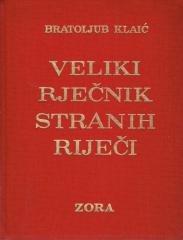
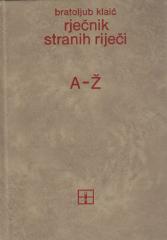
The booklet is rare, available in antiquarian books and digital archives, and represents a significant part of the oeuvre of Bratoljub Klaić, better known for his later Dictionary of Foreign Words.
One copy is available