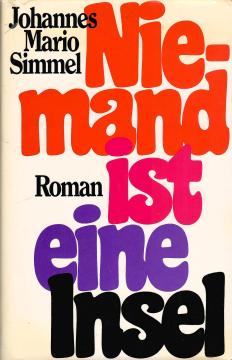
Niemand ist eine Insel

Niemand ist eine Insel

Johannes M. Simmel

The novel "Niemand ist eine Insel" follows film director Robert Flavius, who goes to an isolated island after the war and there confronts the past, guilt, love and the question of human responsibility.

In his novel Niemand ist eine Insel, Johannes Mario Simmel tells a psychological and socially engaged story about a man who tries to escape the world, but cannot escape his own past. The main character, Robert Flavius, a successful film director, retreats to a secluded island in the Aegean Sea after World War II to find peace and a new beginning. However, isolation does not bring oblivion – on the contrary, it forces him to confront his life choices, moral dilemmas and the consequences of the war.

On the island, he meets people whose fates reawaken his repressed memories and raise questions about guilt, responsibility and the possibility of redemption. A particularly important relationship develops between him and a young woman who brings new hope to his life, but at the same time opens up painful themes from the past. Through their conversations and conflicts, it is gradually revealed that no man exists completely separate from others – every decision affects the lives of other people.

The title of the novel is taken from the famous thought of the English poet John Donne: “No man is an island”, with which Simmel emphasizes the main idea of ​​the work – a person is always connected to society, history and the people around him. Trying to escape from the world only reveals how interconnected we are.

The novel deals with the great themes of the 20th century: the consequences of war, dealing with the past, political responsibility, love and the need for understanding between people. Simmel combines a tense plot with a deep moral analysis and asks the question whether an individual can find peace if he does not first accept the truth about himself and his actions. Niemand ist eine Insel is at the same time a love novel, a psychological drama and a strong message about human connection and responsibility.

Maße
22 x 14 cm
Seitenzahl
732
Verlag
Deutscher Bücherbund, Stutgart / München, 1975.
 
Latein Schrift. Fester Einband mit Schutzumschlag.
Sprache: Deutsch.

Angeboten wird ein Exemplar

Zustand:Gebraucht, in ausgezeichnetem Zustand
Reduzierter Preis: 8,465,92
Der Rabatt von 30 % gilt bis zum 12.09.2026 23:59 Uhr
Zum Warenkorb hinzugefügt!
 

Interessieren Sie sich für ein anderes Buch? Sie können das Angebot über unsere Suchmaschine suchen und finden oder Bücher nach Kategorien durchsuchen.

Diese Titel könnten Sie auch interessieren

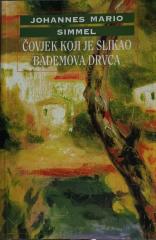
Čovjek koji je slikao bademova drvca

Čovjek koji je slikao bademova drvca

Johannes M. Simmel
Mozaik knjiga, 2001.
Kroatisch. Latein Schrift. Taschenbuch.
4,983,74
Čovjek koji je slikao bademova drvca

Čovjek koji je slikao bademova drvca

Johannes M. Simmel

The author's short novel in which he told the love story of the painter Pierre Mondragon, who captured the hearts of many women on the Cote d'Azur.

Mozaik knjiga, 2009.
Kroatisch. Latein Schrift. Taschenbuch.
3,68
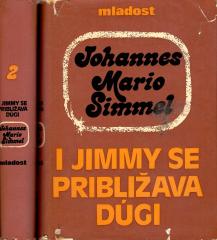
I Jimmy se približava dugi 1-2

I Jimmy se približava dugi 1-2

Johannes M. Simmel

A political and psychological drama set in Vienna between 1938 and 1969. Although inspired by real events from the West German metropolis between 1934 and 1965, the author changed the time and place of the action to protect the identities of real people.

Mladost, 1977.
Kroatisch. Latein Schrift. Fester Einband mit Schutzumschlag.
Das Buch besteht aus zwei Bänden
6,74 - 8,64
Rosa

Rosa

Heike Geißler

With the brilliant debut of Heike Geißler, she conquered the German audience. With a novel about a girl who leaves her newborn baby because she feels she is losing control over her own life and desires, the author tells the story of a generation of lost p

Fraktura, 2006.
Kroatisch. Latein Schrift. Taschenbuch.
5,74
Proces

Proces

Franz Kafka

Kafka wrote The Process between 1914 and 1915, published posthumously in 1925. The novel is unfinished but with an added final chapter by Max Brod. Edition with a foreword by B. Živojinović and an afterword by Walter Killi.

BIGZ, 1990.
Serbisch. Latein Schrift. Taschenbuch.
4,26
Josip i njegova braća II: Mladi Josip

Josip i njegova braća II: Mladi Josip

Thomas Mann

The second part of the tetralogy by German Nobel Prize winner Thomas Mann, Joseph and His Brothers, is entitled Young Joseph. This tetralogy is considered one of the most important works by Thomas Mann, as well as by German literature of the twentieth cen

Fraktura, 2009.
Kroatisch. Latein Schrift. Fester Einband mit Schutzumschlag.
27,34