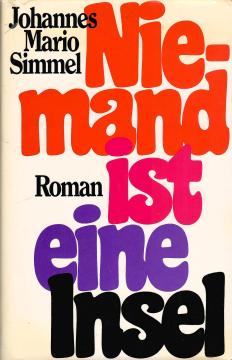
Niemand ist eine Insel

Niemand ist eine Insel

Johannes M. Simmel

The novel "Niemand ist eine Insel" follows film director Robert Flavius, who goes to an isolated island after the war and there confronts the past, guilt, love and the question of human responsibility.

In his novel Niemand ist eine Insel, Johannes Mario Simmel tells a psychological and socially engaged story about a man who tries to escape the world, but cannot escape his own past. The main character, Robert Flavius, a successful film director, retreats to a secluded island in the Aegean Sea after World War II to find peace and a new beginning. However, isolation does not bring oblivion – on the contrary, it forces him to confront his life choices, moral dilemmas and the consequences of the war.

On the island, he meets people whose fates reawaken his repressed memories and raise questions about guilt, responsibility and the possibility of redemption. A particularly important relationship develops between him and a young woman who brings new hope to his life, but at the same time opens up painful themes from the past. Through their conversations and conflicts, it is gradually revealed that no man exists completely separate from others – every decision affects the lives of other people.

The title of the novel is taken from the famous thought of the English poet John Donne: “No man is an island”, with which Simmel emphasizes the main idea of ​​the work – a person is always connected to society, history and the people around him. Trying to escape from the world only reveals how interconnected we are.

The novel deals with the great themes of the 20th century: the consequences of war, dealing with the past, political responsibility, love and the need for understanding between people. Simmel combines a tense plot with a deep moral analysis and asks the question whether an individual can find peace if he does not first accept the truth about himself and his actions. Niemand ist eine Insel is at the same time a love novel, a psychological drama and a strong message about human connection and responsibility.

Dimenzije
22 x 14 cm
Broj strana
732
Nakladnik
Deutscher Bücherbund, Stutgart / München, 1975.
 
Latinica. Tvrde korice s ovitkom.
Jezik: Njemački.

Jedan primjerak je u ponudi

Stanje:Korišteno, u odličnom stanju
Dodano u košaricu!
 

Zanima Vas i neka druga knjiga? Možete pretražiti našu ponudu pomoću tražilice ili prelistati knjige po kategorijama.

Možda će Vas zanimati i ovi naslovi

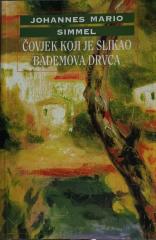
Čovjek koji je slikao bademova drvca

Čovjek koji je slikao bademova drvca

Johannes M. Simmel
Mozaik knjiga, 2001.
Hrvatski. Latinica. Broširano.
4,98
Čovjek koji je slikao bademova drvca

Čovjek koji je slikao bademova drvca

Johannes M. Simmel

Autorov kratki roman u kojem je ispričao ljubavnu priču slikara Pjera Mondragona, koji je osvojio srca mnogih žena na Azurnoj obali.

Mozaik knjiga, 2009.
Hrvatski. Latinica. Broširano.
3,68
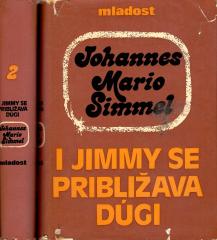
I Jimmy se približava dugi 1-2

I Jimmy se približava dugi 1-2

Johannes M. Simmel

Politička i psihološka drama smeštena u Beč između 1938. i 1969. Iako inspirisan stvarnim događajima iz zapadnonemačke metropole između 1934. i 1965. godine, autor je promenio vreme i mesto radnje da bi zaštitio identitet stvarnih ljudi.

Mladost, 1977.
Hrvatski. Latinica. Tvrde korice s ovitkom.
Knjiga se sastoji od dva toma
6,74 - 8,64
Josip i njegova braća II: Mladi Josip

Josip i njegova braća II: Mladi Josip

Thomas Mann

Drugi deo tetralogije nemačkog dobitnika Nobelove nagrade Tomasa Mana, „Jozef i njegova braća“, nosi naslov „Mladi Josif“. Ova tetralogija se smatra jednim od najvažnijih dela Tomasa Mana, kao i nemačke književnosti dvadesetog veka.

Fraktura, 2009.
Hrvatski. Latinica. Tvrde korice s ovitkom.
27,34
Jadi mladoga Vertera

Jadi mladoga Vertera

Geteovo remek-delo epistolarnog romana iz 1774. (revidirano 1787), ključno za pokret Sturm und Drang, izazvalo je kulturni preokret u Evropi – talas samoubistava, „verterizam“ i imitaciju heroja u modi i sentimentu.

Nolit, 1966.
Srpski. Latinica. Tvrde korice.
4,88
Proces

Proces

Franz Kafka

Kafka je napisao „Proces“ između 1914. i 1915. godine, objavljen posthumno 1925. godine. Roman je nedovršen, ali sa dodatnim završnim poglavljem koje je napisao Maks Brod. Izdanje sa predgovorom B. Živojinovića i pogovorom Valtera Kilija.

BIGZ, 1990.
Srpski. Latinica. Broširano.
4,26