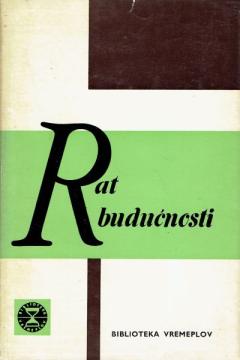
Rat budućnosti: Znanstvena predviđanja o novom oružju

Rat budućnosti: Znanstvena predviđanja o novom oružju

André Beaufre, Vladimir Dedijer, John Cockcroft, David Inglis, Andrew Stratton, Harvey Wheeler, William A. Nierenberg, Marcel Fetizon, Michel Magat, Carl-Göran Hedén, M. W. Thring, Gordon J. F. MacDonald, Otto Klineberg, Philip Noel-Baker, Nigel Calder

A collection of fourteen essays by sixteen distinguished scholars from six countries, predicting the development and threats of new weapons in future wars, especially in the context of the Cold War and technological advances.

Topics include conventional and guerrilla warfare, nuclear weapons, air and space technologies, computer systems, submarine warfare, chemical and microbiological weapons, autonomous weapons, and geophysical warfare. The essay by Gordon J.F. is particularly noteworthy. MacDonald's "How to Wreck the Environment", which warns of the possibility of using technology to manipulate the environment as a weapon.

The authors express concern about the potential destructiveness of new technologies and call for international cooperation and arms control to prevent the escalation of conflicts. The book serves as a warning about the dangers of uncontrolled technological development in a military context.

Titel des Originals
Unless Peace Comes: A Scientific Forecast of New Weapons
Übersetzung
Radovan Stipetić
Editor
Nigel Calder
Titelseite
Ferdo Bis
Maße
21 x 13,5 cm
Seitenzahl
231
Verlag
Stvarnost, Zagreb, 1969.
 
Latein Schrift. Fester Einband mit Schutzumschlag.
Sprache: Kroatisch.

Im Angebot sind keine Exemplare vorhanden

Das letzte Exemplar wurde kürzlich verkauft.
 

Interessieren Sie sich für ein anderes Buch? Sie können das Angebot über unsere Suchmaschine suchen und finden oder Bücher nach Kategorien durchsuchen.

Diese Titel könnten Sie auch interessieren

Filozofija revolucije

Filozofija revolucije

Gamal Abdel Nasser

G. A. Nasser's Philosophy of Revolution is a political manifesto and ideological program of the Egyptian Revolution of 1952. In it, Nasser explains the motives of the revolution, the role of Egypt in the Arab and African world, and the vision of Arab nati

Džepna knjiga, 1956.
Serbisch. Latein Schrift. Taschenbuch.
9,56
Dizanje prošlosti u vazduh: Ogledi o Balkanu i Istočnoj Evropi

Dizanje prošlosti u vazduh: Ogledi o Balkanu i Istočnoj Evropi

Marija Todorova

A collection of essays by the Bulgarian historian Maria Todorova (known for Imaginary Balkans), compiled especially for the 20th Century Library. Indispensable for understanding post-communist transitions, culture of memory and Balkan studies.

Biblioteka XX vek, 2010.
Serbisch. Latein Schrift. Taschenbuch.
8,446,33
Bitka za Moskvu

Bitka za Moskvu

Branko Kitanović

The Battle of Moscow is a historical account of the German Operation "Barbarossa", the Soviet defense and counteroffensive in 1941. The author, with the testimonies of the top Soviet military leaders, shows how the first German defeat in the war unfolded.

Alfa, 1975.
Kroatisch. Latein Schrift. Fester Einband mit Schutzumschlag.
7,96
Hitler osvajač: raskrinkavanje jedne legende

Hitler osvajač: raskrinkavanje jedne legende

Rudolf Olden

One of the first anti-Hitler works, published by Nolit as early as 1933. This is an early, shorter version of the work (originally published anonymously in Prague), which preceded the expanded edition from Amsterdam in 1935.

Nolit, 1933.
Kroatisch. Latein Schrift. Fester Einband mit Schutzumschlag.
15,32
Bormannova braća idu dalje

Bormannova braća idu dalje

William Stevenson

The book reveals the secret network through which Martin Bormann, Hitler's treasurer, ensured the survival of Nazi power and capital after the fall of the Third Reich.

Vjesnik, 1977.
Kroatisch. Latein Schrift. Hardcover.
6,54
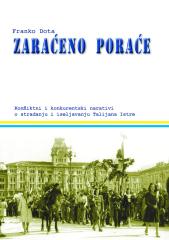
Zaraćeno poraće: Konfliktni i konkurentski narativi o stradanju i iseljavanju Talijana Istre

Zaraćeno poraće: Konfliktni i konkurentski narativi o stradanju i iseljavanju Talijana Istre

Franko Dota

The book analyzes how conflicting historical narratives about the suffering and mass emigration of Italians from Istria and Rijeka developed in Croatia and Italy after World War II (1943–1956), debunking myths and encouraging an empathetic approach to the

Srednja Europa, 2010.
Kroatisch. Latein Schrift. Taschenbuch.
11,32