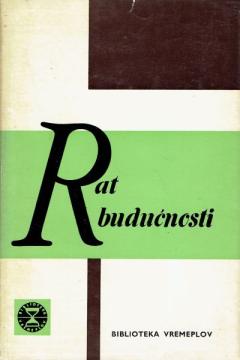
Rat budućnosti: Znanstvena predviđanja o novom oružju

Rat budućnosti: Znanstvena predviđanja o novom oružju

André Beaufre, Vladimir Dedijer, John Cockcroft, David Inglis, Andrew Stratton, Harvey Wheeler, William A. Nierenberg, Marcel Fetizon, Michel Magat, Carl-Göran Hedén, M. W. Thring, Gordon J. F. MacDonald, Otto Klineberg, Philip Noel-Baker, Nigel Calder

A collection of fourteen essays by sixteen distinguished scholars from six countries, predicting the development and threats of new weapons in future wars, especially in the context of the Cold War and technological advances.

Topics include conventional and guerrilla warfare, nuclear weapons, air and space technologies, computer systems, submarine warfare, chemical and microbiological weapons, autonomous weapons, and geophysical warfare. The essay by Gordon J.F. is particularly noteworthy. MacDonald's "How to Wreck the Environment", which warns of the possibility of using technology to manipulate the environment as a weapon.

The authors express concern about the potential destructiveness of new technologies and call for international cooperation and arms control to prevent the escalation of conflicts. The book serves as a warning about the dangers of uncontrolled technological development in a military context.

Naslov izvornika
Unless Peace Comes: A Scientific Forecast of New Weapons
Prijevod
Radovan Stipetić
Urednik
Nigel Calder
Naslovnica
Ferdo Bis
Dimenzije
21 x 13,5 cm
Broj strana
231
Nakladnik
Stvarnost, Zagreb, 1969.
 
Latinica. Tvrde korice s ovitkom.
Jezik: Hrvatski.

Nema primjeraka u ponudi

Poslednji primjerak je nedavno prodan.
 

Zanima Vas i neka druga knjiga? Možete pretražiti našu ponudu pomoću tražilice ili prelistati knjige po kategorijama.

Možda će Vas zanimati i ovi naslovi

Filozofija revolucije

Filozofija revolucije

Gamal Abdel Nasser

G. A. Nasser's Philosophy of Revolution is a political manifesto and ideological program of the Egyptian Revolution of 1952. In it, Nasser explains the motives of the revolution, the role of Egypt in the Arab and African world, and the vision of Arab nati

Džepna knjiga, 1956.
Srpski. Latinica. Broširano.
9,56
Sudbonosni podvig Jugoslavije: Podsjećanje na historijsko NE staljinizmu, događaj koji je opredijelio budućnost Jugoslavije

Sudbonosni podvig Jugoslavije: Podsjećanje na historijsko NE staljinizmu, događaj koji je opredijelio budućnost Jugoslavije

Raif Dizdarević

The book by Raif Dizdarević, one of the last living actors of Yugoslav diplomacy, presents his reconstruction of the most fateful moment of post-war Yugoslavia – the split with Stalin and the Informburo in 1948–1953.

Udruženje za modernu historiju (UMHIS), 2018.
Hrvatski. Latinica. Broširano.
23,58
Razgovor s poviješću

Razgovor s poviješću

Oriana Fallaci

A Conversation with History is not just a collection of interviews, but also a reflection on history, politics, and human nature. The book exposes the complexities of powerful people and their influence on the world, making it a must-read for history and

August Cesarec, 1979.
Hrvatski. Latinica. Tvrde korice s ovitkom.
11,26
Na rubu revolucije - studenti '71.

Na rubu revolucije - studenti '71.

Tihomir Ponoš

This is the first book that comprehensively addresses the phenomenon of Croatian students and their role in the Croatian Spring. Students, along with the reform wing of the League of Communists and Matica Hrvatska, were one of the three pillars of the Cro

Profil International, 2007.
Hrvatski. Latinica. Broširano.
9,567,65
Komunisti Jugoslavije 1919-1979.

Komunisti Jugoslavije 1919-1979.

Pero Morača, Stanislav Stojanović

The book provides an overview of the history of the Communist Party of Yugoslavia (KPJ) from its founding to the late 1970s, emphasizing its role in the revolution, self-government, and construction of Yugoslavia, with an ideologically colored perspective

Eksportpres, 1979.
Srpski. Latinica. Tvrde korice s ovitkom.
11,98
O međunarodnoj situaciji

O međunarodnoj situaciji

Andrej A. Ždanov

A. A. Zhdanov's report from the founding meeting of the Informbiro (Poland, September 1947) on the division of the world into two camps – imperialist (USA) and anti-imperialist (USSR). A key document of the beginning of the Cold War.

Kultura, 1947.
Srpski. Ćirilica. Broširano.
7,46