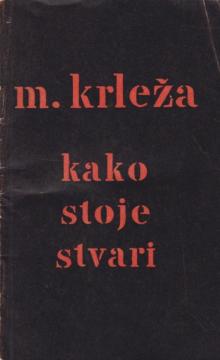
Kako stoje stvari: Predavanje održano u Domu JNA u Zagrebu 17. 12. 1952.
Ein rares Buch

Kako stoje stvari: Predavanje održano u Domu JNA u Zagrebu 17. 12. 1952.

Miroslav Krleža

In his lecture How Things Are (1952), Krleža discusses the political and cultural situation of post-war Yugoslavia, emphasizing the need for critical thought, cultural renewal, and resistance to dogmatism.

“How Things Are” is a transcript of Krleža’s lecture given on December 17, 1952, at the Yugoslav People’s Army House – a speech set in a period of intense political and cultural turmoil following the breakup with the Informbiro. Krleža addresses the audience as a writer, intellectual, and participant in the times, with the intention of explaining what cultural and political work means in a country that is just trying to rebuild itself from the ruins of war and ideological fractures.

Krleža analyzes the state of society without pathos: he speaks of the necessity to break with dogmas, empty phrases, and bureaucratic automatisms that stifle the creative spirit. He emphasizes the importance of education, critical awareness, and cultural openness, contrasting them with the mentality of the “ideological shelf” and the routine that turns the revolution into a mere administrative mechanism. His rhetoric is forceful, but not propagandistic; he insists on the responsibility of intellectuals and the need for society to develop a culture of dialogue, not blind compliance.

The text, like most of Krleža's public speeches, is full of historical references, irony and broad cultural observations. The speech does not hide the tensions of the times: Krleža speaks about the dangers of introversion, the consequences of fanaticism and the meaning of "new delusions" that can appear where thought turns into dogma. At the same time, the text also carries a strong optimistic element - the belief that it is possible to build a society based on knowledge, creativity and freedom of ideas.

As things stand, therefore, it remains an important document of the times and a unique combination of political speech and essay: Krleža's view of the state of society from the perspective of a writer who does not accept simple truths and who believes that culture is the foundation of all true renewal.

Titelseite
Mato Benković
Maße
18,5 x 11,5 cm
Seitenzahl
41
Verlag
Zora, Zagreb, 1953.
 
Latein Schrift. Taschenbuch.
Sprache: Kroatisch.

Angeboten wird ein Exemplar

Zustand:Gebraucht, in ausgezeichnetem Zustand
Zum Warenkorb hinzugefügt!
 

Interessieren Sie sich für ein anderes Buch? Sie können das Angebot über unsere Suchmaschine suchen und finden oder Bücher nach Kategorien durchsuchen.

Diese Titel könnten Sie auch interessieren

Izabrane pjesme

Izabrane pjesme

Miroslav Krleža
Matica hrvatska, 1963.
Kroatisch. Latein Schrift. Fester Einband mit Schutzumschlag.
9,99
Povratak Filipa Latinovicza

Povratak Filipa Latinovicza

Miroslav Krleža

The Return of Filip Latinovicz is one of Miroslav Krleža's most famous novels. This novel is significant in our literature because it is considered the first fully modern Croatian novel.

Večernji list, 2004.
Kroatisch. Latein Schrift. Fester Einband mit Schutzumschlag.
5,524,16 - 5,56
Hrvatski bog Mars

Hrvatski bog Mars

Miroslav Krleža

The Croatian god Mars brings seven anti-war novels in which Krleža portrays war as a cruel, senseless machinery that destroys the "little man", exposing the hypocrisy of militarism and myths about heroism.

Rad, 1965.
Serbisch. Latein Schrift. Taschenbuch.
1,99
Znamenovanje ruske revolucije

Znamenovanje ruske revolucije

Lav N. Tolstoj

Tolstoy interprets the 1905 revolution as a moral upheaval: violence does not bring justice, but a new yoke. He sees lasting liberation in personal conscience, non-violence and Christian love, not in the state and coercion.

St. Kugli, 1907.
Kroatisch. Latein Schrift. Hardcover.
17,24
Čovjek

Čovjek

Maksim Gorki

Man by Maxim Gorky, translated by Ozren Subotić (Vukovar, 1905), is a philosophical and literary work that glorifies the dignity of man, his creative power, freedom of spirit, and the fight against social injustice.

Srijemske novine, 1905.
Kroatisch. Kyrillisch Schrift. Taschenbuch.
17,56
Priče s ostrva, iz grada i sa planine

Priče s ostrva, iz grada i sa planine

Vladimir Nazor

Stories from the Island, from the City and from the Mountain (1927) is a collection of autobiographical stories by Vladimir Nazor. Divided into three cycles, it brings back memories from childhood and youth – life on an island, schooling in the city and a

Matica hrvatska, 1927.
Kroatisch. Latein Schrift. Taschenbuch.
11,26