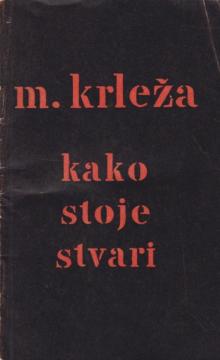
Kako stoje stvari: Predavanje održano u Domu JNA u Zagrebu 17. 12. 1952.
Retka knjiga

Kako stoje stvari: Predavanje održano u Domu JNA u Zagrebu 17. 12. 1952.
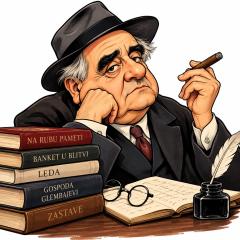
Miroslav Krleža

In his lecture How Things Are (1952), Krleža discusses the political and cultural situation of post-war Yugoslavia, emphasizing the need for critical thought, cultural renewal, and resistance to dogmatism.

“How Things Are” is a transcript of Krleža’s lecture given on December 17, 1952, at the Yugoslav People’s Army House – a speech set in a period of intense political and cultural turmoil following the breakup with the Informbiro. Krleža addresses the audience as a writer, intellectual, and participant in the times, with the intention of explaining what cultural and political work means in a country that is just trying to rebuild itself from the ruins of war and ideological fractures.

Krleža analyzes the state of society without pathos: he speaks of the necessity to break with dogmas, empty phrases, and bureaucratic automatisms that stifle the creative spirit. He emphasizes the importance of education, critical awareness, and cultural openness, contrasting them with the mentality of the “ideological shelf” and the routine that turns the revolution into a mere administrative mechanism. His rhetoric is forceful, but not propagandistic; he insists on the responsibility of intellectuals and the need for society to develop a culture of dialogue, not blind compliance.

The text, like most of Krleža's public speeches, is full of historical references, irony and broad cultural observations. The speech does not hide the tensions of the times: Krleža speaks about the dangers of introversion, the consequences of fanaticism and the meaning of "new delusions" that can appear where thought turns into dogma. At the same time, the text also carries a strong optimistic element - the belief that it is possible to build a society based on knowledge, creativity and freedom of ideas.

As things stand, therefore, it remains an important document of the times and a unique combination of political speech and essay: Krleža's view of the state of society from the perspective of a writer who does not accept simple truths and who believes that culture is the foundation of all true renewal.

Naslovnica
Mato Benković
Dimenzije
18,5 x 11,5 cm
Broj strana
41
Izdavač
Zora, Zagreb, 1953.
 
Latinica. Broširano.
Jezik: Hrvatski.

Jedan primerak je u ponudi

Stanje:Korišćeno, u odličnom stanju
Dodato u korpu!
 

Zanima Vas i neka druga knjiga? Možete pretražiti našu ponudu pomoću pretrage ili prelistati knjige po kategorijama.

Možda će Vas zanimati i ovi naslovi

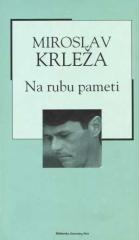
Na rubu pameti

Na rubu pameti

Miroslav Krleža

The novel "On the Edge of Reason" (1938) is Krleža's only novel in the first person. A doctor of law morally condemns a powerful industrialist at a banquet, thereby provoking a general social boycott, persecution, and his own downfall.

Jutarnji list, 2004.
Hrvatski. Latinica. Tvrde korice s omotom.
5,62 €
Povratak Filipa Latinovicza

Povratak Filipa Latinovicza

Miroslav Krleža

The Return of Filip Latinovicz is one of Miroslav Krleža's most famous novels. This novel is significant in our literature because it is considered the first fully modern Croatian novel.

Večernji list, 2004.
Hrvatski. Latinica. Tvrde korice s omotom.
5,52 - 5,56 €
Hrvatski bog Mars

Hrvatski bog Mars

Miroslav Krleža

The Croatian god Mars brings seven anti-war novels in which Krleža portrays war as a cruel, senseless machinery that destroys the "little man", exposing the hypocrisy of militarism and myths about heroism.

Rad, 1965.
Srpski. Latinica. Broširano.
1,99 €
Mrka kapa

Mrka kapa

Aristid Teofanović

Mrka kapa is a book of short prose written under the pseudonym Aristid Teofanović, used by Slobodan Blagojević. Blagojević is also known by the heteronym Anhel Antonić (poetry) and other works under his real name.

Feral Tribune, 2001.
Hrvatski. Latinica. Broširano.
9,36 €
Historijska čitanka 2

Historijska čitanka 2

Miljenko Jergović

The first edition of the second part of the series with 5 new (bonus) stories by a famous writer and journalist. "This book completes the 'Historical Reader', a project - a column started on the pages of the Sarajevo magazine Dani, shortly after the end o

Durieux, 2004.
Hrvatski. Latinica. Tvrde korice.
7,32 €
Mali romani: O vremenima kina, filma i, naročito, Zagreba

Mali romani: O vremenima kina, filma i, naročito, Zagreba

Tahir Mujičić

Small novels consist of several parts, Zginematografi, Kokot u kinu, Special Extras, Biography and the poem Tomorrow Will Spill Me. This is the author's first book about cinemas in the series that followed.

V.B.Z, 2023.
Hrvatski. Latinica. Tvrde korice.
17,24 €