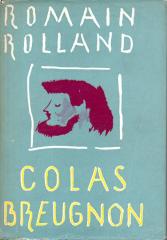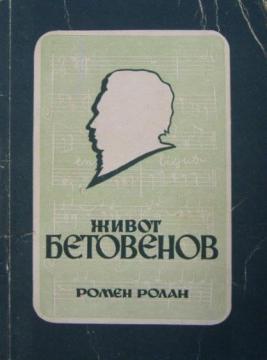
The translation of this book was originally published in 1923 by the Belgrade bookseller S. B. Cvijanović, but the entire edition was confiscated and destroyed by the Germans during the Second World War.
A beautifully bound edition of the book, the interior is immaculately preserved.
Translation
Božidar Kovačević
Dimensions
17 x 12 cm
Pages
122
Publisher
Matica srpska, Novi Sad, 1947.
Latin alphabet. Paperback.
Language: Croatian.
One copy is available
A beautifully bound copy of the book, the interior is immaculately preserved.
"Colas Breugnon" is a charming romance of life in Burgundy three hundred years ago. It is an "autobiographical" novel, the story being told in the first person by Colas, who reviews his fifty years of life, and describes all its joys and sorrows.
Zora, 1952.
Croatian. Latin alphabet. Hardcover with dust jacket.
2.99 €
Francuska književnost • A war novel • Psychological novel
In this work, written during World War I, Rolland contrasts the destructive hatred with the joy of life, humor, and solidarity. Kola is a kind of Burgundian Falstaff or Rabelais' Gargantua – rough but noble, earthly but deeply humane.
Nolit, 1966.
Serbian. Latin alphabet. Hardcover.
3.90 €
A philosophical novel • Psychological novel
If it seems to you that beneath the surface of the sometimes monotonous everyday life lies a hilarious absurdity, David Sedaris will finally convince you of that.
Algoritam, 2010.
Croatian. Latin alphabet. Paperback.
3.98 €
American literature • Essays and diaries • Science Fiction • Popular Science
A popular science work in which Asimov, combining scientific rigor with a lucid style, explores possible threats to the survival of humanity, systematizing disasters according to their nature and probability.
August Cesarec, 1981.
Croatian. Latin alphabet. Hardcover with dust jacket.
7.46 €
Essays and diaries • Croatian literature • A war novel
A moving and poignant chronicle of the siege and destruction of Vukovar in 1991 through 57 short "postcard" chapters. Pavličić does not write from the perspective of an "ordinary" Zagreb resident who spent the summer of 1991 in Vukovar, and then followed