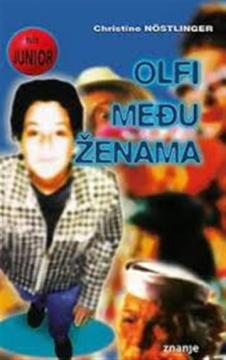
Olfi među ženama

Olfi među ženama

Christine Nöstlinger

The novel humorously and warmly depicts the everyday life of a fourteen-year-old boy, Olfi (Wolfgang), the only man in a house full of women. A classic of Austrian children's literature, it is often read in elementary school.

Olfi lives with seven women: his mother, grandmother, grandmother's sister, two aunts and two sisters. They raise him, protect him, control him and sometimes suffocate him with their authority, habits and feminine rules. Olfi adapts, but in puberty he begins to search for his own identity and a male role model. He reads about Freud and the Oedipus complex, worries that he will become homosexual due to the lack of a father, has a girlfriend, but fears that he is not "manly enough".

The novel is cheerful, humorous and realistic - it shows the problems of adolescence (fear of sexuality, search for identity, conflict with authority) through funny situations, without pathos. Nöstlinger ridicules stereotypes about the "women's world" and "male identity", emphasizing honesty, empathy and acceptance of differences.

The book is intended for young people and parents - easy to read, with warm humor and a deep understanding of the child's soul.

Original title
Olfi und die Frauen
Translation
Štefanija Halambek
Dimensions
19.5 x 12 cm
Pages
150
Publisher
Znanje, Zagreb, 2009.
 
Latin alphabet. Paperback.
Language: Croatian.

Two copies are available

Copy number 1

Condition:Used, excellent condition

Copy number 2

Condition:Used, excellent condition
 

Are you interested in another book? You can search the offer using our search engine or browse books by category.

You may also be interested in these titles

Dekameron

Dekameron

Giovanni Boccaccio

In the Decameron, ten young people fleeing the plague tell stories about love, fate and ingenuity. The adapted version of Ljerka Car Matutinović brings selected novellas, adapted to school, with an emphasis on humor, morality and Renaissance spirit.

Mozaik knjiga, 2002.
Croatian. Latin alphabet. Hardcover.
5.76
Kako smo lomili noge

Kako smo lomili noge

Miro Gavran

The novel How We Broke Our Legs (1997), a humorous and tender chronicle of family life through four decades of Croatian history, follows the fate of three generations of a Slavonian family from 1951 to 1992.

Mozaik knjiga, 2007.
Croatian. Latin alphabet. Paperback.
9.36
Priče iz davnine

Priče iz davnine

Ivana Brlić-Mažuranić

"Stories from the Past" (1916) contains the stories: Sunce Djever and Neva Nevičica, Bratac Jaglenac and little sister Rutvica, Šuma Striborova, How Potjeh searched for the truth, Fisherman Polunko and his wife, Lutonjica Toporko and nine župančići, Jagor

Mozaik knjiga, 2001.
Croatian. Latin alphabet. Hardcover.
9.42
Smogovci i strašni Bongo

Smogovci i strašni Bongo

Hrvoje Hitrec

In the novel, the cheerful Vragec family from Dubrava, Zagreb, faces new adventures. When the mysterious Bongo appears, the boys explore a series of comical and tense events, preserving kindness and togetherness.

August Cesarec, 1987.
Croatian. Latin alphabet. Hardcover.
6.32
Pripovijetke

Pripovijetke

Vjenceslav Novak

This edition brings four key stories by Vjenceslav Novak (1859–1905), one of the most important Croatian realists, known for his social sensitivity and depictions of urban poverty at the turn of the 19th and 20th centuries.

Zagrebačka stvarnost, 2001.
Croatian. Latin alphabet. Hardcover.
6.36 - 7.32