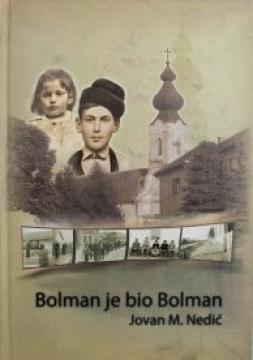
Bolman je bio Bolman

Bolman je bio Bolman

Jovan M. Nedić

Monograph on the Baranja village of Bolman. The book has three main parts: "From the history of the village and the church municipality", "Bolman was Bolman – Vidoja Bijelić's memories" and "Ledari", with a description of Bolman's customs and mentality.

With as many as 758 pages, it belongs to the most comprehensive books about small places such as Bolman. It contains about 350 photos, and to describe what is in those photos, it would take 26 pages. The chapter "Small dictionary of the Bolmanian divan" has 68 pages with 800 definitions. It took 11 pages for the bibliography, and 18 pages for the table of contents. The book also has a "General register of terms" on 28 pages with 1000 items, although only names and titles more important for the book are included in that register. If a complete index of terms had been created, the book would have been at least fifty pages longer. It was printed in 300 copies, and its publication was financed by the Municipality of Jagodnjak.

Some parts of the book are written in Cyrillic, some in Latin, in accordance with the fact that the people of Bolman use both letters. Most of the book is written, of course, in the literary language and with the Ijekavian pronunciation, because that is what the Bolmanians and other Raci from Baranja originally spoke, as the native Serbs of Baranja used to be called. Parts of the book are also written in vivid Bolman divan, because one of the goals of the book was to preserve old words and former Bolman "stories" in as authentic a form as possible.

Editor
Jovan S. Nedić
Illustrations
Milan Dvornić
Dimensions
24 x 17 cm
Pages
758
Publisher
Vlastita naklada, Bolman, 2012.
 
Latin alphabet. Hardcover.
Language: Croatian.
ISBN
978-9-53574-040-7

One copy is available

Condition:New
 

Are you interested in another book? You can search the offer using our search engine or browse books by category.

You may also be interested in these titles

Izvješća iz Tarahumare

Izvješća iz Tarahumare

Ivan Rattkay

The book contains three Latin reports by the Croatian Jesuit, nobleman and explorer Ivan Rattkay (Ratkaj, 1647–1683), born in Ptuj (today Slovenia), sent to the provincial of the Austro-Czech Jesuit province from the mission in northern Mexico.

ArTresor naklada, 1998.
Croatian. Latin alphabet. Hardcover with dust jacket.
9.56
Liburnijske teme 8: Brseč i Brešćina

Liburnijske teme 8: Brseč i Brešćina

"Liburnian Topics" represent a valuable serial publication (proceedings) initiated by the Chair of the Čakavian Parliament in Opatija with the aim of researching and preserving the historical, cultural and natural heritage of the Liburnian region.

Čakavski sabor, 1994.
Croatian. Latin alphabet. Paperback.
12.368.65
Ukrajinski Karpati: Etnogeneza, arheologija, etnologija

Ukrajinski Karpati: Etnogeneza, arheologija, etnologija

The collection is an interdisciplinary bridge between Ukrainian and Croatian science, encouraging comparative research on Slavic migrations. It presents the Carpathians as a "living archipelago" connecting East and West, important for Croatian ethnogenesi

Filozofski fakultet Sveučilišta u Zagrebu, 2014.
Croatian. Latin alphabet. Paperback.
18.34
Eseji i članci

Eseji i članci

Ljubo Karaman

Zbirka Eseji i članci Ljube Karamana, eminentnog povjesničara umjetnosti, obuhvaća niz tekstova o hrvatskoj umjetnosti, s naglaskom na srednjovjekovnu baštinu Dalmacije i njezinu povezanost s europskim kulturnim strujanjima.

Matica hrvatska, 1939.
Croatian. Latin alphabet. Hardcover.
6.484.54 - 10.34
Savremena Evropa ili karakteristika evropskih država i naroda

Savremena Evropa ili karakteristika evropskih država i naroda

Stjepan Radić

Savremena Evropa (1905.) političko-je publicističko djelo Stjepana Radića u kojem autor analizira europske države, narode, kulture i političke sustave te mjesto slavenskih naroda u suvremenoj Europi.

Matica hrvatska, 1905.
Croatian. Latin alphabet. Hardcover.
9.32
Proizvodnja pokljuka u Požeškom Novom Selu: Separat

Proizvodnja pokljuka u Požeškom Novom Selu: Separat

Zdenka Lechner

Zdenka Lechner, the first ethnologist at the Museum of Slavonia (1951–1965), made significant contributions to the study of the traditional culture of Slavonia, including the use of pokljuc – earthen lids for baking bread and pastries on the hearth.

Muzej Slavonije, 1962.
Croatian. Latin alphabet. Paperback.
6.32