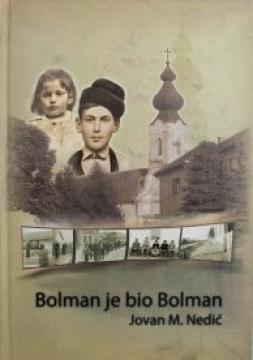
Bolman je bio Bolman

Bolman je bio Bolman

Jovan M. Nedić

Monograph on the Baranja village of Bolman. The book has three main parts: "From the history of the village and the church municipality", "Bolman was Bolman – Vidoja Bijelić's memories" and "Ledari", with a description of Bolman's customs and mentality.

With as many as 758 pages, it belongs to the most comprehensive books about small places such as Bolman. It contains about 350 photos, and to describe what is in those photos, it would take 26 pages. The chapter "Small dictionary of the Bolmanian divan" has 68 pages with 800 definitions. It took 11 pages for the bibliography, and 18 pages for the table of contents. The book also has a "General register of terms" on 28 pages with 1000 items, although only names and titles more important for the book are included in that register. If a complete index of terms had been created, the book would have been at least fifty pages longer. It was printed in 300 copies, and its publication was financed by the Municipality of Jagodnjak.

Some parts of the book are written in Cyrillic, some in Latin, in accordance with the fact that the people of Bolman use both letters. Most of the book is written, of course, in the literary language and with the Ijekavian pronunciation, because that is what the Bolmanians and other Raci from Baranja originally spoke, as the native Serbs of Baranja used to be called. Parts of the book are also written in vivid Bolman divan, because one of the goals of the book was to preserve old words and former Bolman "stories" in as authentic a form as possible.

Editor
Jovan S. Nedić
Illustrations
Milan Dvornić
Dimensions
24 x 17 cm
Pages
758
Publisher
Vlastita naklada, Bolman, 2012.
 
Latin alphabet. Hardcover.
Language: Croatian.
ISBN
978-9-53574-040-7

One copy is available

Condition:New
 

Are you interested in another book? You can search the offer using our search engine or browse books by category.

You may also be interested in these titles

Proizvodnja pokljuka u Požeškom Novom Selu: Separat

Proizvodnja pokljuka u Požeškom Novom Selu: Separat

Zdenka Lechner

Zdenka Lechner, the first ethnologist at the Museum of Slavonia (1951–1965), made significant contributions to the study of the traditional culture of Slavonia, including the use of pokljuc – earthen lids for baking bread and pastries on the hearth.

Muzej Slavonije, 1962.
Croatian. Latin alphabet. Paperback.
6.32
Dizanje prošlosti u vazduh: Ogledi o Balkanu i Istočnoj Evropi

Dizanje prošlosti u vazduh: Ogledi o Balkanu i Istočnoj Evropi

Marija Todorova

A collection of essays by the Bulgarian historian Maria Todorova (known for Imaginary Balkans), compiled especially for the 20th Century Library. Indispensable for understanding post-communist transitions, culture of memory and Balkan studies.

Biblioteka XX vek, 2010.
Serbian. Latin alphabet. Paperback.
8.44
Što su Česi?: kratki pregled činjenica i pokušaj objašnjenja

Što su Česi?: kratki pregled činjenica i pokušaj objašnjenja

Jan Patočka

In the book before you, Jan Patočka wrote a paradigmatic essay on the Central European identity of a Slavic people.

Durieux, 2000.
Croatian. Latin alphabet. Paperback.
7.74
Život i običaji naroda Kine

Život i običaji naroda Kine

Petar Vlahović

The author used various research methods, such as field work, interviews with local residents, study of written sources and other relevant materials.

Naučna knjiga, 1973.
Serbian. Latin alphabet. Paperback.
6.98
Prvi znanstveni sabor Slavonije i Baranje

Prvi znanstveni sabor Slavonije i Baranje

The collection collects works on the history, archaeology, law, settlement and folklore of Slavonia and Baranja. It provides an overview from the Neolithic period through Roman Pannonia and the Middle Ages to the modern era, with an insight into the regio

Jugoslavenska akademija znanosti i umjetnosti (JAZU), 1970.
Croatian. Latin alphabet. Hardcover.
23.62