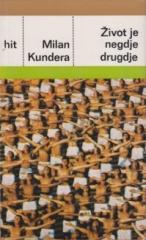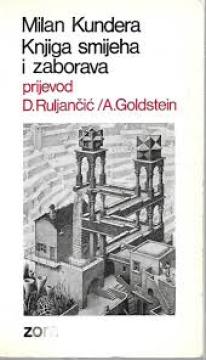
Knjiga smijeha i zaborava

Knjiga smijeha i zaborava

Milan Kundera

The novel The Book of Laughter and Forgetfulness (1979), a fragmentary novel in seven parts, explores Czech history under the communist regime, particularly after the 1968 Prague Spring and the Soviet invasion.

Kundera, an exile in Paris, combines satire, erotic motifs, and philosophical digressions, mocking totalitarianism through stories of the manipulation of memory and identity.

Through characters such as Ludvik, an engineer rehabilitated after a false accusation, and Tamara, who flees into exile, the novel depicts how the regime erases the past – from destroyed monuments to betrayals by friends – while laughter becomes a weapon: angelic (liberating, individual) versus diabolical (collective, destructive). Erotic scenes, such as those between lovers in Paris or during the invasion, emphasize the lightness and heaviness of existence, the conflicts of mind and body, public and private.

Kundera warns that forgetting is not a passive loss, but an active erasure: just as the image of Clementis is erased from history from a photograph next to Gottwald, so personal memories are extinguished. The novel, written in Czech and translated into English, criticizes false narratives and celebrates art as resistance. Relevant in an age of manipulation, Kundera sees it as a "novel of ideas" where history becomes a metaphor for loneliness and hope in laughter.

Titel des Originals
Kniha smíchu a zapomnění
Übersetzung
Albert Goldštajn, Dagmar Ruljančić
Editor
Vjeran Zuppa
Titelseite
Sanja Iveković
Maße
19 x 12 cm
Seitenzahl
262
Verlag
Grafički zavod Hrvatske (GZH), Zagreb, 1982.
 
Latein Schrift. Taschenbuch.
Sprache: Kroatisch.

Angeboten wird ein Exemplar

Zustand:Gebraucht, in ausgezeichnetem Zustand
Nachteile/Unannehmlichkeiten:
  • A message of a personal nature
Zum Warenkorb hinzugefügt!
 

Interessieren Sie sich für ein anderes Buch? Sie können das Angebot über unsere Suchmaschine suchen und finden oder Bücher nach Kategorien durchsuchen.

Diese Titel könnten Sie auch interessieren

Život je negdje drugdje

Život je negdje drugdje

Milan Kundera

Jaromil, ein junger Dichter, der von einer besitzergreifenden Mutter erzogen wurde, sucht in der Poesie und der Revolution nach einem erfüllten Leben. Seine lyrische Jugend, die Liebe und sein Idealismus führen ihn in die Konformität und zum Verrat in int

Znanje, 1979.
Kroatisch. Latein Schrift. Fester Einband mit Schutzumschlag.
4,86
Andrićeva lestvica užasa

Andrićeva lestvica užasa

Svetislav Basara

A Serbian writer known for his satirical novels, Andrić's Ladder of Horrors dissects the Balkan mentality through a parable of Yugo-nostalgia and national myths. The title alludes to Ivo Andrić as a litmus test for criticism – Balkans claim him or reject

24 sata, 2021.
Serbisch. Latein Schrift. Taschenbuch.
11,56
Stotina godina (antikronika)

Stotina godina (antikronika)

Dario Harjaček

The novel One Hundred Years by Dario Harjaček provides a panoramic view of Trešnjevka and its inhabitants through a century of changes, ideologies, and human destinies – a mosaic of Zagreb in which life, art, and history intertwine.

Oceanmore, 2025.
Kroatisch. Latein Schrift. Taschenbuch.
13,42
Neprijatelji / ljubavna priča

Neprijatelji / ljubavna priča

Isaac Bashevis Singer

Enemies: A Love Story, perhaps Singer's best-known novel, takes place in New York in the 1950s.

Svjetlost, 1986.
Kroatisch. Latein Schrift. Fester Einband mit Schutzumschlag.
5,98
Kreutzerova sonata, Hadži-Murat

Kreutzerova sonata, Hadži-Murat

Lav Nikolajevič Tolstoj

Kreutzer's sonata belongs to those works of Tolstoy that the writer adapted in many ways to his view on moral issues, on marital morality above all.

Civitas, 2004.
Kroatisch. Latein Schrift. Taschenbuch.
4,98
Godan

Godan

Munshi Prem Chand
Kosmos, 1960.
Serbisch. Latein Schrift. Taschenbuch.
4,22 - 4,26