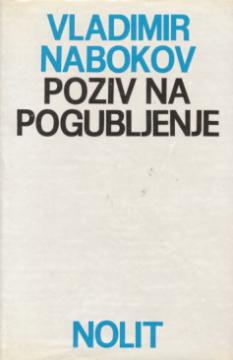
Poziv na pogubljenje

Poziv na pogubljenje

Vladimir Nabokov

There is no doubt that it is most attractive to read The Call to Execution as it appears to be written, as an anti-utopian or anti-totalitarian novel...

Nabokov could indirectly follow the rise of Stalinism in the Soviet Union and directly the rise of National Socialism in Germany; it is also the time of mass trials and public confessions in Moscow, as well as the first Nazi camps in Germany... People in that world are uniform individuals who can change names and functions without any trouble, blend into each other, disappear and reappear. They are the product of an era in which matter grew tired, aged and stopped, and together with it "time sweetly slumbered". Due to the loss of time, the spatial dimensions were also lost, so the world became similar to theater sets between which equally two-dimensional people move... They are "miserable ghosts", puppets with changeable parts, connected by "a single, monolithic, inhuman principle, the principle of general and unconditional cooperation and participation". This heinous principle of collaboration is the basis of all totalitarian regimes, and in this sense, as Mojnahan noted, this book should be read as prophetic. It foreshadowed all the horrors of the Nazi and concentration camps in the Second World War, in which the victim was forced to participate in torture and killing, to lose dignity, individuality and life itself... All this could really lead us to think that it is a real dystopian novel, but Nabokov consistently, from the very beginning, strives to destroy the conventions of this genre.

Übersetzung
Ljiljana Mojsov
Editor
Nikola Bertolino
Titelseite
Žarko Rošulj
Maße
19 x 12,5 cm
Seitenzahl
219
Verlag
Nolit, Beograd, 1988.
 
Auflage: 4.000 Exemplare
 
Latein Schrift. Fester Einband mit Schutzumschlag.
Sprache: Serbisch.

Angeboten wird ein Exemplar

Zustand:Gebraucht, in ausgezeichnetem Zustand
Reduzierter Preis: 12,3211,09
Der Rabatt von 10 % gilt bis zum 21.06.2026 23:59 Uhr
Zum Warenkorb hinzugefügt!
 

Interessieren Sie sich für ein anderes Buch? Sie können das Angebot über unsere Suchmaschine suchen und finden oder Bücher nach Kategorien durchsuchen.

Diese Titel könnten Sie auch interessieren

Prozirnost stvari

Prozirnost stvari

Vladimir Nabokov

Behind the ironic-humorous style with which he portrays Hugh Person, the hero of the novel, Nabokov weaves a serious human drama.

Grafički zavod Hrvatske (GZH), 1980.
Kroatisch. Latein Schrift. Fester Einband mit Schutzumschlag.
5,98
Dijalektika prijelaznog perioda

Dijalektika prijelaznog perioda

Viktor Pelevin

The book represents the author's anthology - the largest part is the novel Čisla (Čisla), followed by the short story Macedonian Criticism of French Thought and several short stories (Odin vog, Akiko, Fokus-grupa, Gost na prazniku bon).

Disput, 2006.
Kroatisch. Latein Schrift. Taschenbuch.
9,68
Sabrana djela A. P. Čehova #7: Seljaci i druge novele

Sabrana djela A. P. Čehova #7: Seljaci i druge novele

Anton Pavlovič Čehov

Zwischen 1892, als „Das Fragment“, die erste Novelle dieses Buches, veröffentlicht wurde, und „Der Bauer“ (1897) und „Auf den Karren“ (1897) schuf A. P. Tschechow eine Reihe weiterer künstlerisch gelungener Beobachtungen der Gesellschaft, in der er lebte.

Zora, 1960.
Kroatisch. Latein Schrift. Fester Einband mit Schutzumschlag.
13,62
Djetinjstvo

Djetinjstvo

Lav Nikolajevič Tolstoj

„Kindheit“ (1852) ist das erste Buch einer autobiografischen Trilogie (mit „Aufwachen“ und „Jugend“), in der Tolstoi die Welt der Kindheit durch die Augen eines zehnjährigen Jungen, Nikolinka Irtenjew, erkundet – Unschuld, Freuden, Sorgen und erste Trauma

Svjetlost, 1971.
Kroatisch. Latein Schrift. Hardcover.
6,54
Sabrana djela A. P. Čehova #4: Dan izvan grada

Sabrana djela A. P. Čehova #4: Dan izvan grada

Anton Pavlovič Čehov

Der vierte Band von Tschechows Werken enthält Novellen und Humoresken, die größtenteils im Jahr 1886 entstanden. Da Tschechow noch immer gegen Bezahlung für Tageszeitungen schrieb, musste er seine Kunst aufgrund des Geschmacks des Lesepublikums oft der Ve

Zora, 1959.
Kroatisch. Latein Schrift. Fester Einband mit Schutzumschlag.
9,56
Ana Karenjina

Ana Karenjina

Lav Nikolajevič Tolstoj

„Anna Karenina“ (1875–1877) ist Leo Tolstois größter und komplexester Roman, der oft als einer der größten Romane der Weltliteratur angesehen wird und für die Tiefe seiner Charaktere und philosophischen Fragen gelobt wird.

Mladost, 1952.
Kroatisch. Latein Schrift. Taschenbuch.
Das Buch besteht aus zwei Bänden
10,36