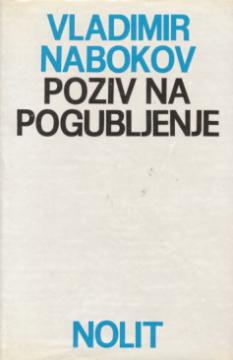
Poziv na pogubljenje
There is no doubt that it is most attractive to read The Call to Execution as it appears to be written, as an anti-utopian or anti-totalitarian novel...
Nabokov could indirectly follow the rise of Stalinism in the Soviet Union and directly the rise of National Socialism in Germany; it is also the time of mass trials and public confessions in Moscow, as well as the first Nazi camps in Germany... People in that world are uniform individuals who can change names and functions without any trouble, blend into each other, disappear and reappear. They are the product of an era in which matter grew tired, aged and stopped, and together with it "time sweetly slumbered". Due to the loss of time, the spatial dimensions were also lost, so the world became similar to theater sets between which equally two-dimensional people move... They are "miserable ghosts", puppets with changeable parts, connected by "a single, monolithic, inhuman principle, the principle of general and unconditional cooperation and participation". This heinous principle of collaboration is the basis of all totalitarian regimes, and in this sense, as Mojnahan noted, this book should be read as prophetic. It foreshadowed all the horrors of the Nazi and concentration camps in the Second World War, in which the victim was forced to participate in torture and killing, to lose dignity, individuality and life itself... All this could really lead us to think that it is a real dystopian novel, but Nabokov consistently, from the very beginning, strives to destroy the conventions of this genre.
One copy is available