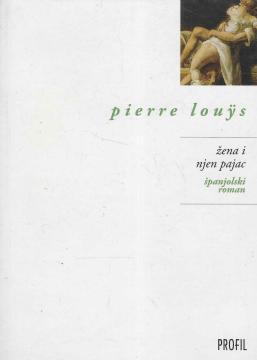
Žena i njen pajac

Žena i njen pajac

Pierre Louÿs

The novel The Woman and Her Clown by Pierre Louÿs tells the passionate story of the beautiful Conchita and her lover André, whose relationship of passion, jealousy, and humiliation shows how love can become a game of power and cruelty.

The Woman and Her Clown (1898) is the most famous work of the French writer Pierre Louÿs, inspired by the Spanish setting and eroticism of the fin de siècle. The novel tells the story of a passionate but destructive relationship between the seductive Spaniard Conchita Pérez and the wealthy Frenchman André Stévens.

At the center of the plot is Conchita – a woman of cold beauty and strong will, who uses love as a weapon. She plays with André’s feelings, alternately offering him tenderness and humiliation. An obsessive relationship develops between them in which love turns into torture and passion into destruction.

Louÿs explores the theme of female power over men, eros as a form of domination and human weakness in the face of desire. Through psychological analysis and an expressive style, the author raises the question: where does love end and addiction begin?

The novel exudes the atmosphere of Andalusia – fiery dance, dark streets and the scent of passion, introducing an exotic tone into the decadent spirit of Parisian literature of the late 19th century.

The work inspired numerous film adaptations, the most famous of which is The Devil Is a Woman (1935) by Josef von Sternberg with Marlene Dietrich in the role of the enigmatic Conchita, and That Obscure Object of Desire (1977) by Luis Buñuel, which interprets the motif of women and dolls in a more modern, symbolic key.

The Woman and her Spider remains a classic story about power, eroticism and humiliation - about love that destroys both the one who loves and the one who rules over love.

Titel des Originals
La Femme et le Pantin
Übersetzung
Marija Paprašarovski
Editor
Maja Zorica
Maße
18 x 13 cm
Seitenzahl
146
Verlag
Profil Knjiga, Zagreb, 2010.
 
Latein Schrift. Taschenbuch.
Sprache: Kroatisch.

Angeboten wird ein Exemplar

Zustand:Gebraucht, in sehr gutem Zustand
Nachteile/Unannehmlichkeiten:
  • Library stamp
Zum Warenkorb hinzugefügt!
 

Interessieren Sie sich für ein anderes Buch? Sie können das Angebot über unsere Suchmaschine suchen und finden oder Bücher nach Kategorien durchsuchen.

Diese Titel könnten Sie auch interessieren

Četrdeset pet vitezova, sv. 1-2

Četrdeset pet vitezova, sv. 1-2

Alexandre Dumas

Alexandre Dumas – The Forty-Five Knights, published in 1966, is part of a grand trilogy about the political and religious turmoil in France during the late 16th century.

Epoha, 1966.
Kroatisch. Latein Schrift. Fester Einband mit Schutzumschlag.
Das Buch besteht aus zwei Bänden
9,48
Ljubičice u srijedu

Ljubičice u srijedu

Andre Maurois

André Maurois, a French writer known for his psychological novels and biographies, explores themes of family relationships, love, and internal conflicts in this work, which is characteristic of his style.

Svjetlost, 1965.
Kroatisch. Latein Schrift. Taschenbuch.
3,42 - 3,62
Oproštajni udarac

Oproštajni udarac

Marguerite Yourcenar

The great writer's short novel The Parting Shot is one of those great works in which the conciseness of the statement and the brevity of the form emanate the fullness of the text and the passion of its meanings.

Svjetlost, 1987.
Kroatisch. Latein Schrift. Taschenbuch.
3,56
Bartolomejska noć: knjiga 1-2

Bartolomejska noć: knjiga 1-2

Alexandre Dumas

Ova knjiga tematizira jedan od najkrvavijih događaja u francuskoj povijesti – Bartolomejsku noć iz 1572. godine, kada su tisuće francuskih protestanata) pobijene u Parizu i diljem zemlje.

Epoha, 1966.
Kroatisch. Latein Schrift. Fester Einband mit Schutzumschlag.
Das Buch besteht aus zwei Bänden
9,36
Tri mušketira 1-2

Tri mušketira 1-2

Alexandre Dumas

Dumasova verzija priče prikazuje avanture d’Artagnana i njegovih prijatelja od 1625 do 1628.

Epoha, 1966.
Kroatisch. Latein Schrift. Fester Einband mit Schutzumschlag.
Das Buch besteht aus zwei Bänden
9,48
Evgenija Grande

Evgenija Grande

Honore de Balzac

"Eugenija Grande" (1833.), dio Balzacove Ljudske komedije, realističan je roman koji istražuje pohlepu, obiteljske odnose i žrtve ljubavi u provincijskom francuskom društvu.

Veselin Masleša, 1989.
Kroatisch. Latein Schrift. Hardcover.
4,98