Žena i njen pajac
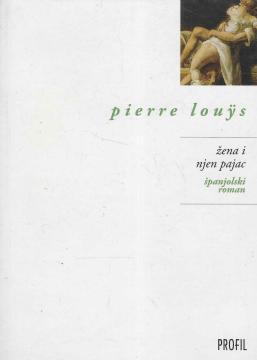
The novel The Woman and Her Clown by Pierre Louÿs tells the passionate story of the beautiful Conchita and her lover André, whose relationship of passion, jealousy, and humiliation shows how love can become a game of power and cruelty.
The Woman and Her Clown (1898) is the most famous work of the French writer Pierre Louÿs, inspired by the Spanish setting and eroticism of the fin de siècle. The novel tells the story of a passionate but destructive relationship between the seductive Spaniard Conchita Pérez and the wealthy Frenchman André Stévens.
At the center of the plot is Conchita – a woman of cold beauty and strong will, who uses love as a weapon. She plays with André’s feelings, alternately offering him tenderness and humiliation. An obsessive relationship develops between them in which love turns into torture and passion into destruction.
Louÿs explores the theme of female power over men, eros as a form of domination and human weakness in the face of desire. Through psychological analysis and an expressive style, the author raises the question: where does love end and addiction begin?
The novel exudes the atmosphere of Andalusia – fiery dance, dark streets and the scent of passion, introducing an exotic tone into the decadent spirit of Parisian literature of the late 19th century.
The work inspired numerous film adaptations, the most famous of which is The Devil Is a Woman (1935) by Josef von Sternberg with Marlene Dietrich in the role of the enigmatic Conchita, and That Obscure Object of Desire (1977) by Luis Buñuel, which interprets the motif of women and dolls in a more modern, symbolic key.
The Woman and her Spider remains a classic story about power, eroticism and humiliation - about love that destroys both the one who loves and the one who rules over love.
One copy is available
- Library stamp