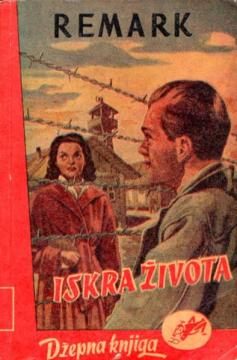
Iskra života

Iskra života

Erich Maria Remarque

Spark of Life follows a group of inmates in a Nazi concentration camp who, despite the constant terror, retain their moral strength and humanity. The novel depicts the struggle of the spirit against systematic destruction and the need for hope.

The Spark of Life by Erich Maria Remarque is a powerful anti-war novel set in a concentration camp during the final months of World War II. The plot focuses on “Block 6,” a section for political prisoners that the Nazi regime considered particularly dangerous. The prisoners are tormented by starvation, disease, forced labor, and daily humiliations, but despite everything, they remain firmly bound by the idea of ​​resistance and the belief that human dignity can survive even in the worst conditions.

The central character, known only as “509,” is severely weakened but mentally unshakable. Through his thoughts and brief but impressive interactions with other camp inmates, Remarque depicts the small gestures of solidarity, defiance, and courage that keep the prisoners alive. The novel also follows the dynamics within the camp: the brutality of the guards, the indifference of the commandant, and the collapse of the system as the war draws to a close.

At the same time, outside the camp, a resistance movement is growing, and the merging of these two worlds culminates in the moment of liberation. Remarque describes how the greatest struggle is not just physical survival, but also the preservation of the “spark of life” – the inner will that gives a person meaning and identity even in the face of death.

The work is an indictment of totalitarianism and dehumanization, but also an ode to the resilience of the human spirit. Through brutal scenes and emotional introspection, Remarque reminds us that humanity is most clearly seen when it is most difficult to preserve.

Titel des Originals
Der Funke Leben
Übersetzung
Ksenija Pešić, Jovanka Bogojević
Editor
Reuf Bravo
Titelseite
Milan Lehner
Maße
16,5 x 11 cm
Seitenzahl
344
Verlag
Džepna knjiga, Sarajevo, 1955.
 
Latein Schrift. Taschenbuch.
Sprache: Serbisch.

Es werden zwei Exemplare angeboten
Kopiennummer 1

Zustand:Gebraucht, in ausgezeichnetem Zustand
Zum Warenkorb hinzugefügt!

Kopiennummer 2

Zustand:Gebraucht, in sehr gutem Zustand
Zum Warenkorb hinzugefügt!
 

Interessieren Sie sich für ein anderes Buch? Sie können das Angebot über unsere Suchmaschine suchen und finden oder Bücher nach Kategorien durchsuchen.

Diese Titel könnten Sie auch interessieren

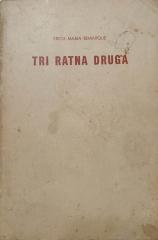
Tri ratna druga

Tri ratna druga

Erich Maria Remarque

Three World War I comrades—Robbie, Otto, and Gottfried—try to survive in Weimar Germany in 1928. Amid economic crisis, poverty, and political violence, their friendship is their only refuge.

Minerva, 1953.
Serbisch. Latein Schrift. Taschenbuch.
1,99
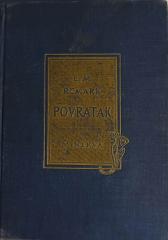
Povratak

Povratak

Erich Maria Remarque
Minerva, 1955.
Kroatisch. Latein Schrift. Hardcover.
1,62 - 1,98
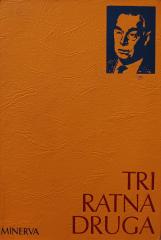
Tri ratna druga

Tri ratna druga

Erich Maria Remarque

Drei Kameraden aus dem Ersten Weltkrieg – Robbie, Otto und Gottfried – versuchen 1928 in der Weimarer Republik zu überleben. Inmitten von Wirtschaftskrise, Armut und politischer Gewalt ist ihre Freundschaft ihr einziger Zufluchtsort.

Minerva, 1978.
Serbisch. Latein Schrift. Hardcover.
3,99 - 8,98
Josip i njegova braća III: Josip u Egiptu

Josip i njegova braća III: Josip u Egiptu

Thomas Mann

The third part of the tetralogy by German Nobel Prize winner Thomas Mann, Joseph and His Brothers, is entitled Joseph in Egypt. This tetralogy is considered one of the most important works by Thomas Mann, as well as by German literature of the twentieth c

Fraktura, 2010.
Kroatisch. Latein Schrift. Fester Einband mit Schutzumschlag.
34,62
Josip i njegova braća II: Mladi Josip

Josip i njegova braća II: Mladi Josip

Thomas Mann

The second part of the tetralogy by German Nobel Prize winner Thomas Mann, Joseph and His Brothers, is entitled Young Joseph. This tetralogy is considered one of the most important works by Thomas Mann, as well as by German literature of the twentieth cen

Fraktura, 2009.
Kroatisch. Latein Schrift. Fester Einband mit Schutzumschlag.
27,34
Proces

Proces

Franz Kafka

Kafka wrote The Process between 1914 and 1915, published posthumously in 1925. The novel is unfinished but with an added final chapter by Max Brod. Edition with a foreword by B. Živojinović and an afterword by Walter Killi.

BIGZ, 1990.
Serbisch. Latein Schrift. Taschenbuch.
4,26