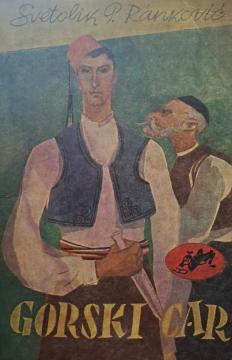
Gorski car

Gorski car

Svetolik Ranković

In the novel Gorski car, which takes place in the countryside, Ranković also describes an event from his own life: while he was on summer vacation in 1886, bandits attacked his family home and killed his father Pavle, while torturing his mother and others

Svetolik managed to escape and bring help under circumstances similar to those described in this novel in the part when he talks about the landlord Đorđe's hoarding. Despite this, the main character of the novel Đurica is not portrayed as a bloodthirsty murderer, but his character is brilliantly psychologically nuanced. The writer managed to demolish the romantic myth of the so-called mountain emperors, and at the same time he gave an excellent picture of society in all its misery. He also expressed his attitude towards the death penalty.

Übersetzung
Slobodan Bogojević
Editor
Reuf Bravo
Maße
16,5 x 11 cm
Seitenzahl
206
Verlag
Džepna knjiga, Sarajevo, 1953.
 
Latein Schrift. Taschenbuch.
Sprache: Kroatisch.

Angeboten wird ein Exemplar

Zustand:Gebraucht, in ausgezeichnetem Zustand
Zum Warenkorb hinzugefügt!
 

Interessieren Sie sich für ein anderes Buch? Sie können das Angebot über unsere Suchmaschine suchen und finden oder Bücher nach Kategorien durchsuchen.

Diese Titel könnten Sie auch interessieren

Van domašaja

Van domašaja

Elmor Lenard

Jack Foley was escaping from the Glades County Jail in Florida when he encountered Karen Sisko armed with a shotgun.

IPS Media, 2009.
Serbisch. Latein Schrift. Taschenbuch.
6,50
Gordo posrtanje

Gordo posrtanje

Vojislav Lubarda

The novel deals with social and moral problems of man in contemporary society. Through the fates of the main characters, the author depicts human arrogance, ambition and the consequences of wrong decisions.

Otokar Keršovani, 1970.
Kroatisch. Latein Schrift. Fester Einband mit Schutzumschlag.
8,18
Gog

Gog

Giovanni Papini

Papini's "Gog", in the edition with an afterword by Mate Ujević, brings a provocative collection of satirical and philosophical writings that expose human weaknesses, social absurdities and the spiritual crisis of modern man.

Knjižnica dobrih romana, 1935.
Kroatisch. Latein Schrift. Hardcover.
2,46 - 5,64
Zlatno telešce

Zlatno telešce

Ilja Iljf, Evgenij Petrov

The Golden Calf (1931) follows the ingenious con artist Ostap Bender, who in Soviet Russia during the first five-year plan seeks a secret millionaire in order to get rich, encountering the absurdity of bureaucracy, the new Soviet man, and his own downfall

Naklada Binoza, 1934.
Kroatisch. Latein Schrift. Fester Einband mit Schutzumschlag.
9,74
Mladost Tome Ivića

Mladost Tome Ivića

Mate Ujević

The Youth of Toma Ivić (1928) is an autobiographical novel by Mate Ujević. It depicts the spiritual wanderings, youthful crises, and final religious conversion of a sensitive young man in the Herzegovina-Dalmatia setting.

Hrvatsko književno društvo Sv. Jeronima, 1928.
Kroatisch. Latein Schrift. Hardcover.
11,32
Ljudi

Ljudi

Pal Szabo

"People" by Pál Szab is a romanticized chronicle of a rural community in which, through everyday life, conflicts, work, and interpersonal relationships, the moral strength, weaknesses, and constant struggle of man for dignity are depicted.

Naklada Binoza, 1932.
Kroatisch. Latein Schrift. Fester Einband mit Schutzumschlag.
5,62