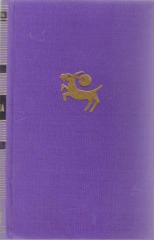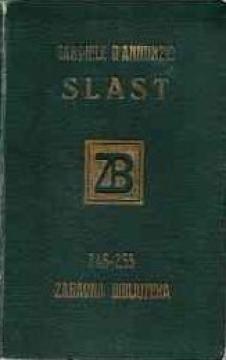
Slast: roman iz života rimske aristokracije
Antique
Rare book

Slast: roman iz života rimske aristokracije

Gabriele D'annunzio

Sweetness is the first novel by Gabriele d'Annunzio, written in 1889 in Francavilla al Mare, and published the following year by Fratelli Treves.

The novel's main character and central theme is the decadent aesthete. The novel is a central text of the Italian decadent literary movement, Decadentism. D'Annunzio was inspired by Huysmans's pioneering work À Rebours, which also strongly influenced Oscar Wilde's novel The Picture of Dorian Gray. The aesthete Andrea is a nobleman who loves only art and is devoted to the worship of his wife Elena. Elena's chimerical nature, however, destroys the protagonist's balance and reveals her as a kind of femme fatale. The style of the novel is also of paramount importance: d'Annunzio adopts a unique writing style full of courtly neologisms, often alternating with assonance and consonance. The work's insistence on a unique, pure language may explain its quasi-manneristic and baroque tones.

Original title
Il Piacere
Translation
Jakov Sedmak
Editor
R. M. Ivanović
Dimensions
18 x 12 cm
Pages
352
Publisher
Naklada kraljevske zemaljske tiskare, Zagreb, 1921.
 
Latin alphabet. Hardcover.
Language: Croatian.

No copies available

The last copy was sold recently.


Are you interested in another book? You can search the offer using our search engine or browse books by category.

You may also be interested in these titles

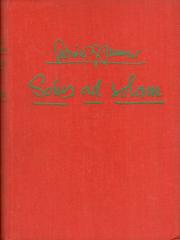
Solus ad solam

Solus ad solam

Gabriele D'annunzio

Solus ad solam (1910/1911) is an intimate, lyrical prose in which the author passionately and erotically describes his love for a woman, mixing ecstasy of body and spirit, poetic exaltation, and decadent sensuality.

Nakladni zavod Ante Velzek, 1940.
Croatian. Latin alphabet. Hardcover with dust jacket.
9.46
Kuća bez čuvara

Kuća bez čuvara

Heinrich Böll

The novel depicts the post-war period in Germany, and Böll, using the strange technique of painting the world from below through the mute mouth of a boy reporter, presents images of the spiritual and material rescue of the female protagonists of fatherles

Zora, 1957.
Croatian. Latin alphabet. Hardcover with dust jacket.
4.00
Crnac

Crnac

Tatjana Gromača

The novel The Black Man begins with the sentence “The house we lived in was wooden.” Wooden houses are reserved for fairy tales and stories for children.

Durieux, 2004.
Croatian. Latin alphabet. Paperback.
6.00
Volio sam ih

Volio sam ih

Miško Kranjec

An autobiographical novel by Slovenian writer Miško Kranjec (1908–1983).

Svjetlost, 1957.
Croatian. Latin alphabet. Hardcover.
5.50
Bolje se rodit bez one stvari nego bez sriće

Bolje se rodit bez one stvari nego bez sriće

Arijana Čulina

After teaching women everything they need to know about their bodies in her first book, which sold 30,000 copies, Goge Bjondina leaves for America in search of her heart and a husband.

Profil International, 2009.
Croatian. Latin alphabet. Paperback.
6.004.80
Svetla pobeda

Svetla pobeda

Baynard Kendrick

Kendrick writes in a dynamic and tense style, with plenty of dialogue and twists, which keeps the reader interested until the very end. The title "Lights of Victory" symbolizes hope and success after difficult trials.

Kosmos, 1956.
Serbian. Latin alphabet. Hardcover with dust jacket.
5.00