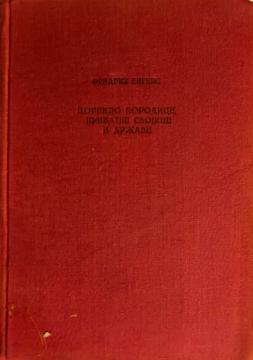
Poreklo porodice, privatne svojine i države

Poreklo porodice, privatne svojine i države

Friedrich Engels
Translation
Milorad Simić
Dimensions
20 x 14 cm
Pages
188
Publisher
Kultura, Beograd, 1950.
 
Distribution: 30,000 copies
 
Cyrillic alphabet. Hardcover.
Language: Serbian.

One copy is available

Condition:Used, very good condition
Damages or inconvenience notice:
  • Traces of patina
  • Slight damage to the cover
  • Signature of previous owner
 

Are you interested in another book? You can search the offer using our search engine or browse books by category.

You may also be interested in these titles

O književnosti i umetnosti

O književnosti i umetnosti

Karl Marx, Friedrich Engels
Rad, 1962.
Serbian. Latin alphabet. Paperback.
0.99
Nemačka ideologija

Nemačka ideologija

Karl Marx, Friedrich Engels
Kultura, 1964.
Serbian. Latin alphabet. Paperback.
3.99
Organizacija poslova i vrednovanje rada

Organizacija poslova i vrednovanje rada

Dušan Janičić, Momčilo Živković

Performance evaluation is key to fairly rewarding employees. This includes assessing the work tasks, competencies and contributions of each employee.

Institut za unapređenje robnog prometa, 1986.
Serbian. Latin alphabet. Paperback.
10.26
The Naked Manager

The Naked Manager

Robert Heller

Reveals how today's managers can avoid the million-dollar mistakes that many top executives continue to make despite their highly paid consultants and business-school wisdom

Coronet Books, 1974.
English. Latin alphabet. Paperback.
4.35
Poduzetništvo: realnost sadašnjosti i izazov budućnosti

Poduzetništvo: realnost sadašnjosti i izazov budućnosti

Marin Buble, Dejan Kružić

In six chapters, the author addresses current problems and perspectives for the development of entrepreneurship and small businesses.

RRiF-plus, 2006.
Croatian. Latin alphabet. Paperback.
7.98
Kraj siromaštva: Ekonomske mogućnosti našeg doba

Kraj siromaštva: Ekonomske mogućnosti našeg doba

Jeffrey Sachs

In the book, economist Jeffrey Sachs presents an optimistic plan for eliminating extreme poverty by 2025. He argues that this is feasible with political will, because world wealth is growing, and poverty is not fate, but the result of inefficient systems.

Algoritam, 2007.
Croatian. Latin alphabet. Paperback.
9.78