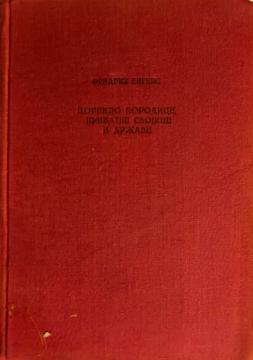
Poreklo porodice, privatne svojine i države

Poreklo porodice, privatne svojine i države

Friedrich Engels
Translation
Milorad Simić
Dimensions
20 x 14 cm
Pages
188
Publisher
Kultura, Beograd, 1950.
 
Distribution: 30,000 copies
 
Cyrillic alphabet. Hardcover.
Language: Serbian.

One copy is available

Condition:Used, very good condition
Damages or inconvenience notice:
  • Traces of patina
  • Slight damage to the cover
  • Signature of previous owner
 

Are you interested in another book? You can search the offer using our search engine or browse books by category.

You may also be interested in these titles

O književnosti i umetnosti

O književnosti i umetnosti

Karl Marx, Friedrich Engels
Rad, 1962.
Serbian. Latin alphabet. Paperback.
0.99
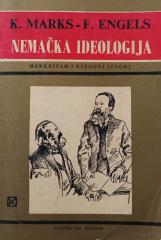
Nemačka ideologija

Nemačka ideologija

Karl Marx, Friedrich Engels
Kultura, 1964.
Serbian. Latin alphabet. Paperback.
3.99
Kaotika

Kaotika

Philip Kotler, John A. Caslione

Management and Marketing in Turbulent Times. An indispensable guide for business leaders who strive to survive today's economic storms and thrive in tomorrow's inevitable turbulence.

Mate d.o.o, 2009.
Croatian. Latin alphabet. Paperback with dust jacket.
5.24
The Demographic Cliff: How to Survive and Prosper During the Great Deflation Ahead

The Demographic Cliff: How to Survive and Prosper During the Great Deflation Ahead

Harry S. Dent

Bestselling author and financial guru Harry Dent shows why we’re facing a “great deflation” and what to do about it now.

Penguin books, 2015.
English. Latin alphabet. Paperback.
14.28
Analiza bilansa

Analiza bilansa

Paul Gerstner

The book is one of the classic works in the field of business finance and accounting, which had a significant influence on the development of the theory and practice of financial statement analysis, especially the balance sheet of a company.

Štamparija Drag Gregorić, 1933.
Serbian. Latin alphabet. Hardcover.
12.62
Kraj siromaštva: Ekonomske mogućnosti našeg doba

Kraj siromaštva: Ekonomske mogućnosti našeg doba

Jeffrey Sachs

In the book, economist Jeffrey Sachs presents an optimistic plan for eliminating extreme poverty by 2025. He argues that this is feasible with political will, because world wealth is growing, and poverty is not fate, but the result of inefficient systems.

Algoritam, 2007.
Croatian. Latin alphabet. Paperback.
9.78