Gilles Deleuze
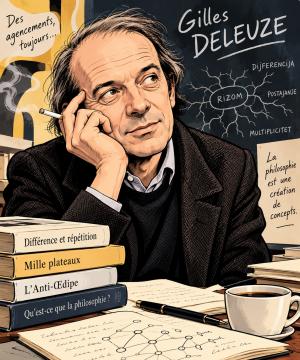
Gilles Deleuze (January 18, 1925 – November 4, 1995) was a French philosopher, one of the most influential thinkers of the second half of the 20th century. Born in Paris to a bourgeois family, he grew up during the Nazi occupation. His father was an engineer, a World War I veteran with anti-Semitic views. Deleuze's older brother Georges was arrested during the Nazi occupation for participating in the resistance movement and died on the way to Auschwitz – a traumatic experience that deeply marked the young Gilles.
He studied philosophy at the Sorbonne from 1944, where he was shaped by Hyppolite and Canguilhem. He taught at lycées, the Sorbonne, Lyon and from 1969 at the experimental University of Paris VIII in Vincennes, where he was a favorite professor until his retirement in 1987. He married Fanny Grandjouan in 1956, with whom he had two children. He suffered from severe emphysema of the lungs and committed suicide by jumping from a window in 1995.
He began his career with monographs on classical philosophers, among which studies on Hume (Empiricism and Subjectivity, 1953), Nietzsche (1962), Kant, Proust, Bergson and Spinoza stand out. Key independent works are Difference and Repetition (1968) and Logic of Meaning (1969), in which he develops the ontology of difference, repetition, the virtual and immanence.
In 1969, he met Félix Guattari, with whom he created some of the most powerful works of the 20th century: Anti-Oedipus (1972), a radical critique of psychoanalysis, family, and capitalism, and A Thousand Plateaus (1980), a nomadic ontology of rhizomes, deterritorialization, and bodies without organs. Together, they also published books on Kafka and What is Philosophy? (1991).
In his later works, he dealt with art – Francis Bacon: The Logic of Sensation (1981), two books on film (Image-Movement and Image-Time), and Criticism and the Clinic (1993).
Deleuze's philosophy emphasizes immanence, rhizomatic thought, becoming, and affects, and criticizes hierarchical structures. He has had a profound influence on poststructuralism, cultural studies, film theory, and political philosophy.