Bertrand Russell
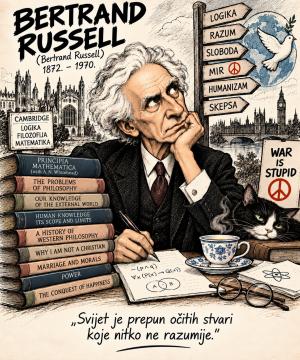
Bertrand Arthur William Russell (Trellech, Wales, May 18, 1872 – Penrhyndeudraeth, Wales, February 2, 1970) was a British philosopher, mathematician, logician, essayist, and social critic, one of the founders of analytic philosophy and among the most influential intellectuals of the 20th century. He came from an aristocratic family and was educated at the University of Cambridge, where he later taught philosophy and mathematics. His intellectual development was marked by an endeavor to clarify philosophical problems through the logical analysis of language and thought.
Together with Alfred North Whitehead, he authored the monumental work Principia Mathematica (1910–1913), in which he sought to derive the foundations of mathematics from logical principles. In his works The Principles of Mathematics (1903), The Problems of Philosophy (1912), and Our Knowledge of the External World (1914), he explored the relationship between logic, knowledge, and reality. His theory of descriptions and the discovery of Russell’s paradox had a decisive influence on the development of modern logic and the philosophy of language.
Among his more significant works are Introduction to Mathematical Philosophy (1919), The Analysis of Mind (1921), The Analysis of Matter (1927), Marriage and Morals (1929), The Conquest of Happiness (1930), Power: A New Social Analysis (1938), An Inquiry into Meaning and Truth (1940), A History of Western Philosophy (1945), and Human Knowledge: Its Scope and Limits (1948). In his essay Why I Am Not a Christian (1927), he critically examined religious beliefs and their social role.
Russell was an advocate for freedom of thought, pacifism, social reform, and human rights. Due to his opposition to the First World War, he lost his teaching position at Cambridge and was imprisoned in 1918. Following the Second World War, he became particularly active in opposing nuclear weapons, helping to initiate the Russell–Einstein Manifesto (1955) and the international peace movement.
In 1950, he was awarded the Nobel Prize in Literature for his diverse body of work, in which he championed humanitarian ideals and freedom of thought. His legacy—which combines mathematical rigor, philosophical skepticism, British humor, and social responsibility—has left a profound mark on contemporary philosophy, logic, and public intellectual discourse.