Antun Gustav Matoš
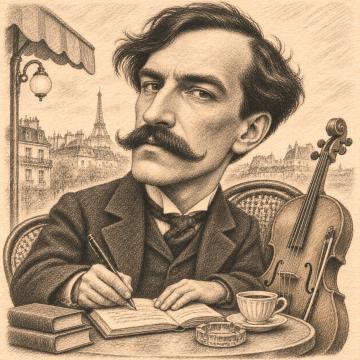
Antun Gustav Matoš (1873–1914) was a Croatian poet, short-story writer, travel writer and literary critic, and a leading figure in Croatian literary modernism. Born in Tovarnik, he grew up in Zagreb. After leaving his veterinary studies in Vienna, he was conscripted into the army. He deserted and moved to Belgrade, where he supported himself by playing the cello alongside his literary and journalistic work. He also lived in Geneva and Paris before returning to Zagreb in 1908, where he continued to write and take part in literary debates.
His short story Moć savjesti (1892) foreshadowed his interest in the troubled conscience and the boundary between reality and fantasy. During his lifetime he published three collections of stories, Iverje (1899), Novo iverje (1900) and Umorne priče (1909). Scenes of daily life in Zagreb and the Zagorje region alternate with grotesque and symbolic tales. In Cvijet sa raskršća, a meeting between a traveller and a blind girl becomes a story of longing and the fleeting nature of an encounter.
His poetry drew on the French Symbolists and Parnassians, especially Charles Baudelaire. He paid close attention to the rhythm and sound of verse, and the sonnet was one of his favourite forms. In Utjeha kose, Jesenje veče and Notturno, images of death, landscape and night shape the mood of each poem. In the travel sketches collected in Naši ljudi i krajevi (1910) and Vidici i putovi (1912), he links landscapes with their people and history, as well as with his own impressions of place. As a critic and columnist, he valued the individuality of a writer’s style, and his polemics were known for their wit and sharpness.
Titles in our offer

Djela XIV: Theatralia: Scenski pokušaji, članci o kazalištu i koncertima, dio drugi (1910.–1913.)
Četrnaesti tom prvog izdanja Matoševih sabranih dela donosi pozorišne i koncertne kritike iz perioda 1910–1913, potvrđujući Matoša kao vrhunskog estetičara i kulturnog kritičara.

Djela XVII: Kritike: Prikazi i polemike iz hrvatske i srpske književnosti i plastičnih umjetnosti (1910.–1913.)
Sedamnaesti, poslednji tom prvog izdanja Matoševih sabranih dela objedinjuje književnu i umetničku kritiku i polemiku iz perioda 1910–1913, zaokružujući njegov kritički opus.

Djela XVI: Kritike: Prikazi i polemike iz hrvatske i srpske književnosti i plastičnih umjetnosti (1905.–1909.)
The sixteenth volume of the first edition of Matoš's collected works brings together literary and art criticism and polemics from the period 1905–1909, confirming Matoš as one of the most prominent critics of Croatian modernism.

Djela XV: Kritike: Prikazi i polemike iz hrvatske i srpske književnosti i plastičnih umjetnosti (1896.–1904.)
The fifteenth volume of the first edition of Matoš's collected works brings together literary and art criticism and polemics from the period 1896–1904, revealing Matoš as a perceptive aesthetician and critic.
Izabrane pjesme
The French school of taste and form, as well as the tradition of Croatian lyricism from Štoos to Kranjčević, is the ground on which the most distinctive Croatian poetic personality grew.

Lijepa naša domovina i drugi putopisi
The collection contains Our Beautiful Homeland, Around the Lobor and about twenty other travelogues, with the addition of notes, interpreters and dictionaries for each individual travelogue.
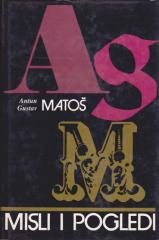
Misli i pogledi
Matoš's thoughts from his almost endless literary and journalistic reading.

Naši ljudi i krajevi: Pejzaži, novele, crtice
"Our People and Regions" is a collection of essays and travelogues by A. G. Matoš from 1910. The collection provides a deep insight into the Croatian regions and people of the early 20th century, reflecting Matoš's love for his homeland and his ability to