Robert Graves
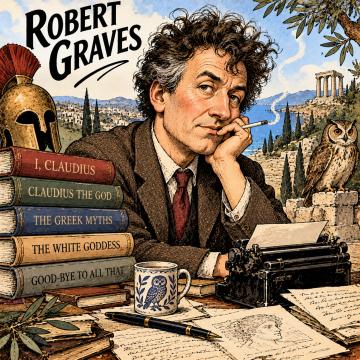
Robert Graves (Wimbledon, London, July 24, 1895 – Deià, Mallorca, December 7, 1985) was a British poet, novelist, essayist, and scholar of mythology, and one of the most significant English writers of the 20th century. He came from an educated family, was educated at Charterhouse, and subsequently studied at the University of Oxford. During the First World War, he served as an officer in the British Army and was severely wounded. His wartime experiences profoundly shaped his literary work.
He began his literary career with the poetry collection Over the Brazier (1916) and attracted public attention with the autobiographical work Good-Bye to All That (1929), in which he offers a critical portrayal of the war, British society, and his own upbringing. After the war, he dedicated himself to literature, and from 1929 onwards, he spent the greater part of his life on Mallorca.
He achieved worldwide fame with the historical novels I, Claudius (1934) and Claudius the God (1934), in which he depicts the political intrigues, violence, and decadence of the Roman Empire through the life of the Roman Emperor Claudius. The novels are distinguished by historical authenticity, psychological characterization, and an ironic narrative style. Works dedicated to mythology and poetic tradition hold a special place in his body of work. In the book The White Goddess (1948), he developed a personal theory regarding the mythical sources of poetic inspiration, while in The Greek Myths (1955), he systematically presented and interpreted ancient mythological lore. His mythological interpretations were influential, yet also the subject of scholarly criticism.
Throughout his life, Graves published numerous poetry collections, novels, and essays, regarding poetry as the core of his literary vocation. His work bridges classical tradition, history, mythology, and modern psychology.
He died in 1985 on Mallorca, where he was also buried. He is remembered as a versatile writer and exceptional storyteller whose works enduringly blend historical imagination, mythical symbolism, and the modern literary experience.
Titles in our offer
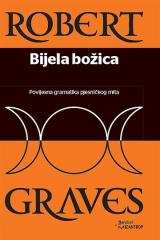
Bijela božica
The White Goddess - A Historical Grammar of Poetic Myth was originally published in 1948 and contains Graves' controversial and unorthodox theory of mythology, at once intuitive and grounded in research into pre-classical religions.
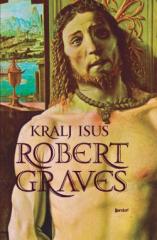
Kralj Isus
'King Jesus' has been declared one of the most controversial historical novels of all time. In it, Robert Graves confirmed his exceptional literary-historical erudition and made a great effort to produce a magnificent account of the life of Christ.
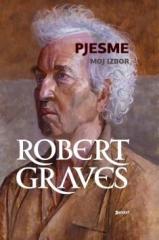
Pjesme: Moj izbor
It is a collection that Robert Graves personally compiled and revised several times (first published by Penguin in 1957). It presents the author's own view of his poetic work, which spanned more than six decades.