Friedrich Nietzsche
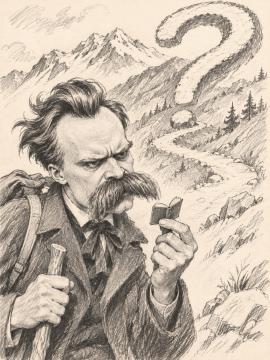
How would you live if you knew you would have to relive every moment of your life countless times? In The Gay Science (1882), Friedrich Nietzsche puts the question in the mouth of a demon who approaches a person in solitude. The idea of eternal recurrence becomes a personal challenge. How much of what we do would we be willing to choose again?
Nietzsche (Röcken, 1844 – Weimar, 1900) studied classical philology and became a professor in Basel in 1869 at the age of twenty-four. Poor health led him to resign in 1879, and he spent the following years in Switzerland, Italy and France. After a collapse in Turin in 1889, he never returned to creative work.
In his first book, The Birth of Tragedy (1872), he interprets Greek tragedy through the tension between the Apollonian and the Dionysian, between the well-defined image and a rapture that dissolves the boundaries of the individual. In Human, All Too Human (1878), he turns to the aphorism. A few sentences on friendship, art or vanity are enough to shake a conviction the reader may never have questioned.
In Thus Spoke Zarathustra (1883–1885), a speaker leaves his mountain solitude to bring unsettling messages to others. Nietzsche draws on the rhythms of sermons, parables and parody to explore how people might overcome themselves and create values. The declaration “God is dead,” also familiar from The Gay Science, sharpens the question of what can ground those values when traditional faith loses its authority.
In Beyond Good and Evil (1886) and On the Genealogy of Morality (1887), Nietzsche investigates the history of moral judgements. He asks how words such as “good,” “evil” and “guilt” acquire power over people. In Twilight of the Idols (1889), he brings the same scrutiny to inherited philosophical beliefs. His readers often have to pause precisely where the meaning of a word had seemed settled long ago.