Platon
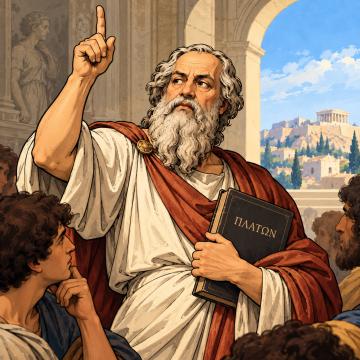
Plato (Greek: Πλάτων, Plátōn, 428/427 – 348/347 BC) is one of the greatest philosophers in the history of mankind. A student of Socrates and teacher of Aristotle, founder of the Academy in Athens and author of philosophical dialogues that are the foundation of Western philosophy, ethics, politics and metaphysics.
Born into an aristocratic Athenian family (real name Aristocles), Plato is considered the most influential philosopher of antiquity and the entire Western tradition. As a young man, he witnessed the Peloponnesian War and political turmoil in Athens. After Socrates' death in 399 BC, disillusioned with Athenian democracy, he left political life and devoted himself to philosophy.
He traveled throughout Greece, Egypt and southern Italy, and around 387 BC founded the Academy in Athens – the first European university and the oldest scientific institution in the West, which operated for almost 900 years. Among his students, the most famous is Aristotle.
Plato presented his teachings almost exclusively in the form of philosophical dialogues, in which the main interlocutor is usually his teacher Socrates. His most important works (by period) include:
- Socratic period: Defense of Socrates (Ἀπολογία Σωϰράτους), Criton (Κρίτων), Protagoras (Πρωταγόρας), Ion (Ἴων), Laches (Λάχης), Republic (Πολιτεία, book I), Lysidas (Λύσις), Charmides (Χαρμίδης);
- transitional period: Gorgius (Γοργίας), Menon (Μένων), Eutidemus (Εὐϑύδημος), Hippias Minor (Ἱππίας ἐλάττων), Cratylus (Κράτυλος), Hippias Greater (Ἱππίας μείζων), Menexenus (Μενέξενος);
- mature period: Feast (Συμποσιον), Phaedon (Φαίδων), State (Πολιτεία, II–X), Phaedar (Φαῖδρος);
- late period: Theaetetus (Θεαίτητος), Parmenides (Παρμενίδης), Sophist (Σοφιστής), Statesman (Πολιτιϰός), Philebus (Φίληβος), Timaeus (Τίμαιος), Critia (Κριτίας), Laws (Νομοι). Of the surviving letters, the most important is the Seventh Letter.
The central ideas of his philosophy are the theory of ideas (a world of eternal, perfect forms above the sensible world), the immortality of the soul, ethical intellectualism, and the belief that knowledge is memory (anamnesis). Plato profoundly influenced Christianity (through Neoplatonism), the Renaissance, idealism, and all of Western thought.
He died in 347 BC in Athens at the age of 80. His writings have been preserved almost in their entirety and constitute the foundation of philosophy, political theory, pedagogy, and aesthetics. Plato is not just a philosopher – he is the founder of Western philosophy as a systematic discipline and one of the greatest thinkers of all time.
Titles in our offer

Gorgija: O sofistima
Plato's dialogue Gorgias (c. 380 BC) in which Socrates debates with Gorgias, Polus, and Callicles about the nature of rhetoric, power, justice, and the good life. A harsh criticism of the Sophists and their oratory as flattery rather than knowledge.