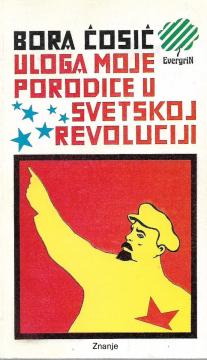
Uloga moje porodice u svetskoj revoluciji
Rare book

Uloga moje porodice u svetskoj revoluciji

Bora Ćosić

The boy Bora tells the story of a chaotic family in Belgrade during the war and the post-war revolution. Mom, dad, grandfather, uncle and aunts live an absurd everyday life full of laughter, chaos and irony, while the "world revolution" enters their apart

My Family's Role in the World Revolution by Bora Ćosić (1969) is a short novel, winner of the NIN award, and one of the most important works of Serbian (and Yugoslav) literature of the second half of the 20th century. It is written from the perspective of the boy Bora, which provides a naive, simple, almost diary-like narrative that masterfully reveals the absurdity of major historical events.

The plot follows the life of a large, dysfunctional Belgrade family during World War II and immediately after it, during the establishment of socialism. The main characters are: a paranoid and disorganized Mom, an alcoholic Dad who cannot hold down a job, a grandfather who doubts everything, an uncle (a transvestite), two aunts obsessed with Hollywood stars, and the narrator – the boy Bora. The family lives in constant chaos: they constantly talk, argue, recite, draw, eat, cry, and dream. War and occupation are almost secondary to them – family rituals and trifles are more important.

Ćosić ingeniously uses humor and absurdity to criticize and demystify great historical events. The revolution enters the house through the partisans and the new authorities who occupy the apartment, preach equality, but bring new bureaucracy, injustice and hypocrisy. The sentences are short, naive, like children's, but polished to perfection – each one carries a multi-layered meaning. The laughter is liberating, subversive and bitter; in the end the boy realizes that everything was that way or even worse.

The book is an autobiographical family epic, but also a sharp satire on the communist revolution, myths about the partisans and the new social order. It shows how ideology enters everyday life, changes relationships and turns ordinary people into players in a grand play. The style is innovative, modern, full of irony, an inventory of objects, language and the madness of the era.

The novel was dramatized twice in Atelje 212, and a film Bate Čengić (1971) was made based on it, which was soon banned. Today it is considered a must-read for understanding the Yugoslav 20th century – witty, painful and deeply humane. It can be read on any page and always brings a smile and recognition.

Editor
Zlatko Crnković
Illustrations
Dušan Otašević
Graphics design
Alfred Pal
Dimensions
19.5 x 12.5 cm
Pages
128
Publisher
Znanje, Zagreb, 1987.
 
Latin alphabet. Paperback.
Language: Serbian.

Two copies are available

Copy number 1

Condition:Unused

Copy number 2

Condition:Used, excellent condition
 

Are you interested in another book? You can search the offer using our search engine or browse books by category.

You may also be interested in these titles

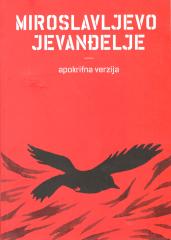
Miroslavljevo jevanđelje – apokrifna verzija

Miroslavljevo jevanđelje – apokrifna verzija

Bora Ćosić

A hilarious comic for which the script was written by Bora Ćosić, and drawn by four comic book authors from Croatia and Serbia - Igor Hofbauer, Damir Steinfl, Boris Stanić and Wostok, while the editor is Saša Rakezić (Aleksandar Zograf), together with Oli

Kulturni centar Beograda, 2012.
Serbian. Latin alphabet. Paperback.
12.56
Lov na dvoličnu puru

Lov na dvoličnu puru

Mark Twain

"The Hunt for the Two-Faced Goose" is a humorous story by Mark Twain in which the author depicts human greed, gullibility, and a tendency to exaggerate through comic situations.

Naprijed, 1964.
Croatian. Latin alphabet. Paperback.
4.58
Pjesme I – Lirske pjesme, Prigodnice, Šaljive pjesme, Epigrami

Pjesme I – Lirske pjesme, Prigodnice, Šaljive pjesme, Epigrami

August Šenoa

Book 9 of the Collected Works of August Šenoa brings a selection of his most significant poetry. From romantic and patriotic lyrical poems to occasional poems to witty humorous poems and sharp epigrams – all in Šenoa's recognizable style.

Naklada knjižare Preporod, 1943.
Croatian. Latin alphabet. Hardcover.
9.35
Humor i satira

Humor i satira

Radoje Domanović

"Humor i Satira" by Radoje Domanović (1935) is a selection of the most famous satirical stories by the Serbian master of satire. A critique of society, politics and mentality through a witty and sharp style.

Luča, biblioteka zadruge Profesorskog društva, 1935.
Serbian. Latin alphabet. Hardcover.
8.32
Žrtva lihvara

Žrtva lihvara

Svatopluk Čech

Svatopluk Čech's novella depicts the conflict between the peaceful, honest manager of Hrdlička and the ruthless usurer Jestřáb. The story is a harsh social critique of usury, exploitation, and the downfall of the common man under the pressure of monetary

Tisak i naklada knjižare Janka Dujaka, 1910.
Croatian. Latin alphabet. Paperback.
14.36
Knjiga bez predgovora

Knjiga bez predgovora

Zyr Vukelić

A collection of humorous stories, sketches, novellas and satirical writings with illustrations by Slavko Voroš. Light, witty prose about the Zagreb bourgeoisie and petty bourgeoisie.

Matica hrvatska, 1914.
Croatian. Latin alphabet. Hardcover.
13.26