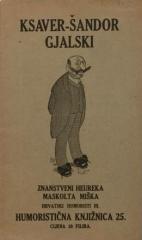
Ksaver Šandor Gjalski
Ksaver Šandor Gjalski (real name Ljubomil Tito Josip Franjo Ksaver Kraljević; 26 October 1854, Gredice – 9 February 1935, Zagreb) was a Croatian prose writer, columnist and publicist, a key figure of realism from the transition to modernity. He came from a noble family; a lawyer by education (studied in Varaždin, Zagreb and Vienna), he served as a district head and grand prefect in northern Croatia. He actively participated in public life: he was a member of parliament, president of the Society of Croatian Writers (1914–1921) and a member of the Croatian Academy of Sciences and Arts. He took the literary name “Gjalski” after his birthplace (Grailski/Gjalski brijeg).
Gjalski combined realistic recording of social relations and psychological miniature. Thematically, it is related to the Zagorje and provincial environment, the bourgeois and aristocratic classes, the processes of modernization and the collapse of old social patterns. In style, it cultivates an elegant, rhythmic sentence, mild irony, a salon atmosphere and "quiet dramaturgy" of internal ruptures. It introduces refined psychology, a chronicle approach and a series of typical characters of "little people", clerks and disempowered gentlemen into Croatian prose.
Bibliography (selection and cycles):
Under the Old Roofs (1886, expanded 1887) – a cycle of stories about the decadence of the nobility and the disappearance of "old times"; a canonical work of realism.
In the Night (1887) – stories with emphasized psychological tension and atmosphere.
On the Mother's Breast (1890) – pictures of life in the Croatian province.
Radmilović (1894) – a novel about the conflict between idealism and politics, a social cross-section of the end of the century.
For the Motherland's Word (1902) – prose with the theme of national and cultural work.
The Arrival of the Croats (1906) – a historical-essay text, a reflection of the author's cultural ideology.
Miserable Stories (1908; in Complete Works, series II, vol. IV, Piščeva naklada 1913) – short realistic miniatures about the quiet misery and vanities of the province.
In the Yellow House (1909; in Complete Works, series IV, vol. I, Piščeva naklada 1914) – a novel about the masks of politeness and the psychology of a petty-bourgeois environment.
Janko Borislavić (1910) – a novel-confession about artistic sensibility and social pressures.
Plitvice Lakes (1911) – travelogue and essay prose.
Complete works (Piščeva naklada, 1913–1914, several series and volumes) – the author's curated edition that solidified the canon.
In addition to prose, he published feuilletons, political and cultural articles in Vienca, Obzor, Hrvatska misla, etc. He was translated into several languages; his works have been adapted for film and dramatized (especially motifs from Pod starim krovovima). His reception places him between realism and fin de siècle: his ironic distance, social sensitivity and stylistic elegance are often highlighted. In Croatian literary history, he stands alongside Kumičić and Leskovar as a key prose writer of the late 19th and early 20th centuries, important for the development of the psychological short story and the bourgeois novel.
Bibliographical notes:
- First systematic edition: Complete Works (Piščeva naklada, Zagreb, 1913–1914), serially arranged into thematic and genre units.
- Later editions and selections: Školska knjiga, Zora/Znanje, Matica hrvatska, etc., with frequent school selections Pod starim krovovima, Janko Borislavić, U noći, Bijedne priče. Legacy and manuscripts: HAZU and libraries in Zagreb preserve manuscript and epistolary material, useful for studying the genesis of texts and the author's cultural policy.
Titles in our offer
Diljem doma: zapisci i priče
„Diljem doma: zapisci i priče“ Ksavera Šandora Gjalskog (1899.) zbirka je realističkih crtica, zapisa i priča iz hrvatskog, ponajviše zagorskog života, s naglaskom na propadanje plemstva i slike domaće svakodnevice.

Ljubav Lajtnanta Milića i druge pripovijetke
Zbirka Ljubav lajtnanta Milića i druge pripovijetke Ksavera Šandora Gjalskog sadrži niz pripovijedaka koje istražuju teme ljubavi, društvenih normi i osobnih dilema u kontekstu tadašnjeg hrvatskog društva.
Osvit: Slike iz tridesetih godina
Povijesni roman o hrvatskom narodnom preporodu (ilirstvu) u 1830-ima. Prvo značajnije Gjalskijevo djelo iz povijesne proze, realističko-romantičarski prikaz buđenja nacionalne svijesti.

Pod starimi krovovi: Zapisci i ulomci iz plemenitaškoga svieta
Pod starimi krovovi (1886.) zbirka je pripovijesti Ksavera Šandora Gjalskog. Realistički i nostalgično prikazuje propadanje zagorskih plemićkih kurija, starih običaja i sukob generacija u doba raspada feudalnog društva.
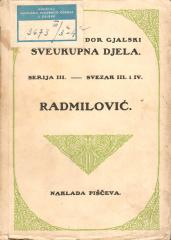
Radmilović
Radmilović (1913) is Gjalski's novel about the collision of ideals and reality: an intellectual full of high principles gets stuck in provincial politics, love and ambition, while the masks of decency slowly peel away.
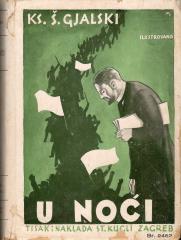
U noći: Svagdašnja povijest iz hrvatskoga života
The young idealistic lawyer Kačić becomes involved in political struggles, party intrigues, corruption and public life, facing the decline of ideals, moral compromises and the dark side of Croatian politics and society.
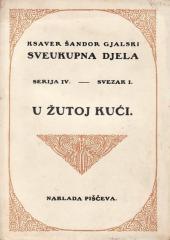
U žutoj kući
Gjalski's novel In the Yellow House (1914) exposes provincial everyday life: masks of politeness, quiet ambitions, and gentle, ironic clashes between desire and duty, told with fine psychology and style. Rare antiquarian edition.