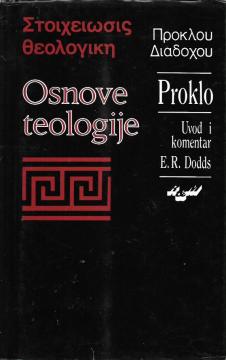
Osnove teologije
Rare book

Osnove teologije

Proklo

Proclus Diadochos (412–485), a Neoplatonist philosopher, systematically presents his metaphysical and theological philosophy, based on the Platonic tradition, with the influence of Plotinus and Iamblichus, in his work Elements of Theology (Elementatio The

The work is structured as a series of axioms and propositions, logically connected, with the aim of explaining the nature of reality, God, and the relationship between the one and the many.

Proclus begins with the concept of the One (to Hen), an absolute, transcendent principle above all categories, which is the source of all that exists. All that exists emanates from the One through a series of hierarchically ordered levels: Mind (Nous), Soul (Psyche), and the material world. Each level participates in the higher, but is limited by its nature. Proclus introduces the concept of henadas, divine units that mediate between the One and the lower levels, allowing for diversity within unity.

The central theme is causality: everything emanates from the One, but causes remain present in their effects, and effects return to their causes (procession and return). Proclus also considers time and eternity, where eternity is a property of higher beings, while time is a characteristic of lower, changing levels.

The work is significant because it synthesizes Neoplatonism into a coherent system, influencing Christian theology (e.g. Pseudo-Dionysius) and medieval philosophy. Proclus' rigor and logical precision make the Foundations of Theology a key text for understanding Neoplatonist metaphysics.

Original title
Στοιχείωσις θεολογική
Translation
Antun Slavko Kalenić
Editor
E. R. Dodds
Graphics design
Ratko Janjić-Jobo
Dimensions
23 x 15 cm
Pages
418
Publisher
Naprijed, Zagreb, 1997.
 
Latin alphabet. Hardcover with dust jacket.
Language: Croatian.

No copies available

The last copy was sold recently.
 

Are you interested in another book? You can search the offer using our search engine or browse books by category.

You may also be interested in these titles

Skriveno lice vremena

Skriveno lice vremena

Michael Hulin

The Hidden Face of Time (1985) by Michel Hulin, a French Indologist and historian of religions, explores the concept of death and the afterlife through a comparative analysis of different cultures and religious traditions.

Naprijed, 1989.
Croatian. Latin alphabet. Hardcover with dust jacket.
11.52
Razmeđa azijskih filozofija 1-2

Razmeđa azijskih filozofija 1-2

Čedomil Veljačić

The two great Asian cultures, Indian and Chinese, reach the peak of their development in the middle of the last millennium of the old era, in a period that is called axial in the history of culture.

Sveučilišna naklada Liber (SNL), 1978.
Croatian. Latin alphabet. Hardcover with dust jacket.
The book consists of two volumes
36.96
Anđeoski naučitelj: Sveti Toma Akvinski

Anđeoski naučitelj: Sveti Toma Akvinski

Jacques Maritain

The book by Jacques Maritain, a French philosopher, written in the spirit of neo-Thomism, presents Thomas as a key figure in Western thought, whose philosophy and theology offer answers to the spiritual and intellectual challenges of the modern age.

Zadruga Eneagram, 2011.
Croatian. Latin alphabet. Paperback.
16.24
Religija unutar granica čistog uma

Religija unutar granica čistog uma

Immanuel Kant
BIGZ, 1990.
Serbian. Latin alphabet. Hardcover with dust jacket.
16.24
Vedanta: Glas slobode

Vedanta: Glas slobode

Swami Vivekananda

A collection of writings by the Indian philosopher and spiritual teacher, published posthumously, based on his speeches and writings. Svāmī Ćetanananda selected 104 essays from the mature period of Svāmī Vivekānanda, from 1893 to his death in 1902.

Naprijed, 1992.
Croatian. Latin alphabet. Hardcover with dust jacket.
18.26
Selected books

Selected books

C. S. Lewis

Selected Books (2002) by C. S. Lewis is a collection of his most important works, covering theological, philosophical, and literary topics.

Harper Collins Publishers, 2002.
English. Latin alphabet. Paperback.
7.24