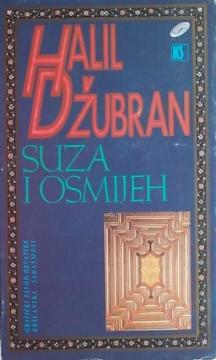
Suza i osmijeh
Rare book

Suza i osmijeh

Halil Džubran

A collection of short lyrical prose writings, poems, and reflections from Gibran's early work. Published in 1914, the work belongs to his Arabic period and exudes mystical longing, spiritual quest, and acceptance of the duality of life.

The main thread of the work is the harmony of opposites: tears (pain, sadness, longing, purification of the soul) and smiles (joy, love, celebration of existence). The author does not want to replace tears with a multitude of superficial joys or turn sadness into false laughter. Tears reveal to him the secrets of life and connect him with the suffering of others, while smiles express gratitude to God and closeness to people.

Through the prism of nature (flowers, clouds, rivers, wind) and symbols of love, death, eternity and the divine, Gibran shows that true happiness is not in avoiding pain, but in accepting it together with joy. The longing for the unattainable (love, perfection, God) is nobler than a languid, hopeless life without passion.

The work clearly manifests the aspiration for spiritual union with the Beloved (God), and the impossibility of fully realizing ideals on earth does not discourage - on the contrary, it nourishes the soul and leads towards eternity.

The collection is an intimate, poetic meditation on the meaning of existence through the prism of tears and smiles as two inseparable faces of the human experience.

Original title
Dam'a wa ibitsama
Translation
Esad Duraković
Editor
Nenad Popović, Esad Duraković
Graphics design
Zoran Pavlović
Dimensions
18 x 11 cm
Pages
156
Publisher
Kršćanska sadašnjost, Zagreb, 1990.
 
Distribution: 3,000 copies
 
Latin alphabet. Paperback.
Language: Croatian.

One copy is available

Condition:Used, excellent condition
 

Are you interested in another book? You can search the offer using our search engine or browse books by category.

You may also be interested in these titles

Mirisni plodovi duše

Mirisni plodovi duše

Halil Džubran

Fragrant Fruits of the Soul (the title of the Croatian edition) is a collection of poetic prose, aphorisms, meditations, and lyrical fragments. Like other early works, it exudes mystical longing, a spiritual rebellion against materialism, and a search for

Kršćanska sadašnjost, 1990.
Croatian. Latin alphabet. Paperback.
5.46
Duhovne izreke

Duhovne izreke

Kahlil Gibran

A collection of short, poetic wisdom and philosophical reflections on life, love, the soul, freedom, and spirituality. Gibran subtly blends Eastern mysticism and Western philosophy in lyrical, profound sayings that encourage the search for inner truth.

Grafos, 1981.
Serbian. Latin alphabet. Paperback.
6.52
Bosa

Bosa

Vanda Mikšić

Fusions in search of fragments of identity, in a combination of verses and prose fragments, are at the forefront of this collection.

MeandarMedia, 2024.
Croatian. Latin alphabet. Paperback with dust jacket.
14.74
Tigris / Tigar

Tigris / Tigar

Tomislav Marijan Bilosnić

The bilingual Hungarian-Croatian edition of the poem collection "Tiger" presents a selection from an extensive cycle of around 150–200 poems about the tiger - a symbol of strength, freedom, wilderness, the cosmos, the subconscious and the return to the pr

Magyar Napló, 2023.
Hungarian. Latin alphabet. Paperback.
5.38
Crni zec (sabrane i nove pjesme)

Crni zec (sabrane i nove pjesme)

Drago Glamuzina

The title poem, "The Black Rabbit," represents a kind of symbolist maneuver within "real" poetry, because like Baudelaire's "Albatross," it possesses a pronounced unambiguous charge.

Vuković & Runjić, 2022.
Croatian. Latin alphabet. Paperback.
8.56 - 9.98
88

88

Nadija Rebronja

A piano usually has 88 keys, 52 white and 36 black, from which 88 tones emerge. A pianist usually reads 88 notes. These 88 micro-proses simultaneously constitute one piano and one piano concerto.

Buybook, 2022.
Croatian. Latin alphabet. Paperback.
5.944.75