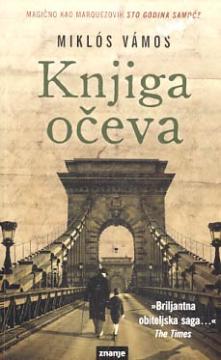
Knjiga očeva

Knjiga očeva

Miklos Vamos

Twelve men in generational succession represent the main characters of this magnificent family saga that spans the last three hundred years of Hungarian history.

The reader is drawn into an exciting story that follows the fate of unforgettable characters. Some are happy, successful and long-lived, while some live their lives, marry the wrong women and die young. Fathers pass on to their sons the unusual ability to see the past and the future, as well as the book in which their notes are stored (Book of Fathers).

In 1705, little Kornel Csillaga returned with his grandfather and mother from Bavaria to his native Hungary. Wars and misery are raging all over Europe. At the scene of one of the countless battles, they find an egg-shaped pocket watch that forever marks the life of the Csillaga family. Sons are born with the unusual ability to see the past and the future, but without the power to influence it. And their lives are both beautiful and sad, successful and unhappy, long-lasting or just flashy, but all written in the Book of Fathers, which, along with the history of the family, also tells about the history of their homeland.

Original title
Apak konyve
Translation
Xenia Detoni
Editor
Davor Uskoković
Graphics design
Janka Carev
Dimensions
19 x 12.5 cm
Pages
483
Publisher
Znanje, Zagreb, 2011.
 
Latin alphabet. Paperback.
Language: Croatian.
ISBN
978-9-53324-012-1

One copy is available

Condition:Used, excellent condition
 

Are you interested in another book? You can search the offer using our search engine or browse books by category.

You may also be interested in these titles

Shannonov put

Shannonov put

Archibald Joseph Cronin

Cronin's moving story of redemption. Robert Shannon, a fanatical doctor-researcher, sacrifices love and life for science, but in the end loses everything – his girlfriend, recognition, health – only to realize through suffering: medicine without humanity

Otokar Keršovani, 1966.
Croatian. Latin alphabet. Hardcover with dust jacket.
6.24
Usta puna zemlje

Usta puna zemlje

Branimir Šćepanović

The novel "Usta puna zemlje" (1970), the masterpiece of the Serbian writer Branimir Šćepanović, is a psychologically in-depth explorer of the limits of the human soul, solitude and existential freedom, reminiscent of Kafka and Camus.

BIGZ, 1987.
Serbian. Latin alphabet. Paperback.
3.98
Zagrepčanka

Zagrepčanka

Branislav Glumac

Branislav Glumac published a novel without periods or commas in 1974, as the relentless stream of thought of a young rebel. Published in socialist Yugoslavia, the work caused a scandal with its openness and became a classic about generational rebellion.

IROS, 1986.
Croatian. Latin alphabet. Hardcover.
8.24
Rudnik čvaraka

Rudnik čvaraka

Tomislav Šovagović

The debut work of Croatian writer Tomislav Šovagović, awarded the Josip and Ivan Kozarac Award in 2012, is a dedication to Slavonia – the region of his childhood that the author, born in Dalmatia, observes with foreign but tender eyes.

Mozaik knjiga, 20112.
Croatian. Latin alphabet. Paperback.
11.56
Strasti i druge pripovijetke

Strasti i druge pripovijetke

Isaac Bashevis Singer

Winner of the Nobel Prize for Literature in 1978, Isaac Bashevis Singer is a prolific writer of novellas and short stories. And in this collection of short stories, the author's penchant for mysticism, grotesque, folklore and eroticism is expressed.

Svjetlost, 1986.
Croatian. Latin alphabet. Hardcover with dust jacket.
6.42
Proces

Proces

Franz Kafka

Kafka wrote The Process between 1914 and 1915, published posthumously in 1925. The novel is unfinished but with an added final chapter by Max Brod. Edition with a foreword by B. Živojinović and an afterword by Walter Killi.

BIGZ, 1990.
Serbian. Latin alphabet. Paperback.
4.26