Izvanbračna veza

Izvanbračna veza

Herbert S. Strean

In recent decades, we have witnessed enormous changes in the culture of conventional sexual relations. Herbert S. Strean analyzes the reasons, dynamics, and consequences of adultery, as well as the psychological processes behind betrayal, desire, and the

In his book The Extramarital Affair, psychotherapist Herbert S. Strean explores the complex psychology of adultery, not by morally condemning it, but by trying to understand the deeper emotional and unconscious motives that lead to it. The author presents extramarital affairs as a symptom of unmet needs within a marriage — the need for attention, understanding, freedom, or affirmation of one's own worth. Strean analyzes how affairs often reveal a hidden conflict between the desire for intimacy and the fear of losing autonomy. He also addresses the consequences of adultery on partners, families, and the therapeutic process, offering insights into the possibility of emotional recovery and relationship renewal. The book is based on clinical experience and combines a psychodynamic approach with empathy for human vulnerability, presenting extramarital affairs as a complex attempt by a person to find what is missing in their own life and marriage.

Original title
The Extramarital Affair
Translation
Marijan Krmpotić
Editor
Mirjana Dobrović
Graphics design
Ratko Janjić
Dimensions
23 x 15 cm
Pages
252
Publisher
Naprijed, Zagreb, 1981.
 
Latin alphabet. Hardcover with dust jacket.
Language: Croatian.

No copies available

The last copy was sold recently.

 

Are you interested in another book? You can search the offer using our search engine or browse books by category.

You may also be interested in these titles

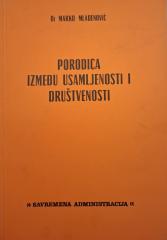
Porodica između usamljenosti i društvenosti

Porodica između usamljenosti i društvenosti

Marko Mladenović

The work analyzes the function of the family as a fundamental social community, its transformations, and the tension between individualism and togetherness within family relationships.

Savremena administracija, 1976.
Serbian. Latin alphabet. Paperback.
4.98
Potčinjenost žena

Potčinjenost žena

Džon Stjuart Mil

King Petar Karađorđević the Liberator, the creator of the state of the Serbs, Croats and Slovenes, based his political program on Milo's treatise On Freedom.

Službeni glasnik, 2008.
Serbian. Latin alphabet. Paperback.
4.42
Društvena teorija i socijalizam: Sociološko-političke studije

Društvena teorija i socijalizam: Sociološko-političke studije

Veljko Cvjetičanin

The book represents a serious theoretical contribution to the understanding of the relationship between modern social theory and socialist practice, with a special focus on the Yugoslav self-governing society.

Centar za kulturnu djelatnost (Cekade), 1986.
Croatian. Latin alphabet. Paperback.
4.98
Zašto baš ja: knjiga o nasilju među djecom

Zašto baš ja: knjiga o nasilju među djecom

Hrvoje Kovačević, Gordana Buljan-Flander

Why Me is a book about violence among children, combining a literary and professional approach. It consists of two parts: an artistic part, made up of stories by writer Hrvoje Kovačević, and a professional part, written by psychologist Gordana Buljan-Flan

Znanje, 2005.
Croatian. Latin alphabet. Hardcover.
6.72
Kapitalistička revolucija: Pedeset postavki o blagostanju, jednakosti i slobodi

Kapitalistička revolucija: Pedeset postavki o blagostanju, jednakosti i slobodi

Peter L. Berger

Peter L. Berger's book is a sociological analysis of capitalism as a cataclysmic force in modern society. Berger's thesis is that capitalism is not just an economy, but a revolutionary process that changes the material, social, political, and cultural asp

Naprijed, 1995.
Croatian. Latin alphabet. Paperback with dust jacket.
9.56
Zaraćeno poraće: Konfliktni i konkurentski narativi o stradanju i iseljavanju Talijana Istre

Zaraćeno poraće: Konfliktni i konkurentski narativi o stradanju i iseljavanju Talijana Istre

Franko Dota

The book analyzes how conflicting historical narratives about the suffering and mass emigration of Italians from Istria and Rijeka developed in Croatia and Italy after World War II (1943–1956), debunking myths and encouraging an empathetic approach to the

Srednja Europa, 2010.
Croatian. Latin alphabet. Paperback.
11.32