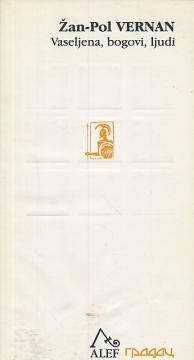
Vaseljena, bogovi, ljudi

Vaseljena, bogovi, ljudi

Jean-Pierre Vernant

Vernant first told the stories published in this book to his grandson, and then, in a more complex form, he told them to his friends on summer evenings on a Greek island.

The Universe, Gods, and People says that myths are the comprehensiveness of life. They preserve the secret of creation, the relationship of the gods to creation, and also the position of man in this world and the next. The path of Greek myths leads from the stories of nannies (as Plato put it) to the tragedies on the ancient stages. But this path continued to Shakespeare, Racine, and Corneille, so that we can meet them again in Freud's psychoanalysis, as well as in the everyday life and behavior of modern man: in murders, adulteries, and incest, in punishments and heroism, in the relationship of life to death, of this world to the afterlife, in man's wanderings through the ambushes and traps of life.

The life and the world summarized in these myths - Vernant wants to tell us - do not require us to bypass reality and modernity. On the contrary, he tells us, in fact, that reality and modernity in some separate form do not exist. The boy's need for his grandfather's story, as well as the friend's need for Vernant – the storyteller – to remind them of those famous ancient events, shows that today's desire for storytelling is necessary, that it awakens in every being a curiosity to find out what happened in those times, in illo tempore, when people and things took on forms that are slowly but surely being consumed today in the great speed and emptiness of life, in a time when the richness of language is being lost, as it too adapts to given circumstances. That is why we all know that losing a connection with those times is a loss of the ability to understand man and to accept the world.

Original title
L'univers, les dieux, les hommes
Translation
Aleksandra Mančić
Editor
Branko Kukić
Graphics design
Mile Grozdanić
Dimensions
22 x 12 cm
Pages
156
Publisher
Gradac, Čačak, 2002.
 
Latin alphabet. Paperback with dust jacket.
Language: Serbian.

One copy is available

Condition:Used, very good condition
Damages or inconvenience notice:
  • Stains on cover
 

Are you interested in another book? You can search the offer using our search engine or browse books by category.

You may also be interested in these titles

Apostol Kine: P. Matteo Ricci, DI (1552.-1610.)

Apostol Kine: P. Matteo Ricci, DI (1552.-1610.)

Otello Gentili

September 10, 1583, is the birthday of modern Catholic missions in China. On that day, two Jesuits, Fathers Ricci and Rugeri, set foot in Zhao qing, thus beginning the evangelization of that vast country.

Filozofsko-teološki institut Družbe Isusove, 2002.
Croatian. Latin alphabet. Paperback.
7.32
Pashalna urota: Novo tumačenje Isusova života i smrti

Pashalna urota: Novo tumačenje Isusova života i smrti

Hugh J. Schonfield

The author claims that Jesus, aware of the messianic prophecies, carefully planned his life, arrest, crucifixion, and fake death to fulfill the prophecies. The plan failed due to a Roman soldier's spear – Jesus died, and the resurrection was later mytholo

Stari grad, 2003.
Croatian. Latin alphabet. Hardcover.
9.626.73 - 9.687.74
Bijela božica

Bijela božica

Robert Graves

The White Goddess - A Historical Grammar of Poetic Myth was originally published in 1948 and contains Graves' controversial and unorthodox theory of mythology, at once intuitive and grounded in research into pre-classical religions.

Sandorf, 2016.
Croatian. Latin alphabet. Hardcover.
22.46
Nije kao med i mlijeko: Bog nakon komunizma

Nije kao med i mlijeko: Bog nakon komunizma

Andras Mate Toth, Pavel Mikluščak

The first part of the collection discusses the method of pastoral theology in the context of communism, and then the social presence of the Church in post-communist societies, from Caritas to the media.

Kršćanska sadašnjost, 2001.
Croatian. Latin alphabet. Paperback.
9.25
Kultura neandertalaca: Čuvari drevne mudrosti

Kultura neandertalaca: Čuvari drevne mudrosti

In this strongly documented book, the British psychologist and researcher claims that Neanderthals were the bearers of an older, more powerful, and spiritually richer culture than Cro-Magnon ("modern" man), and that it was their tradition that formed the

Stari grad, 2006.
Croatian. Latin alphabet. Hardcover.
14.2410.68 - 14.2810.71
Dječja Biblija: Najvažnija knjiga na svijetu - Biblija ispričana tako da je razumiju i djeca

Dječja Biblija: Najvažnija knjiga na svijetu - Biblija ispričana tako da je razumiju i djeca

Pat Alexander

This book, the Children's Bible, provides a concise history of mankind as recorded in the Bible.

Jutarnji list, 2004.
Croatian. Latin alphabet. Paperback.
3.52 - 3.58