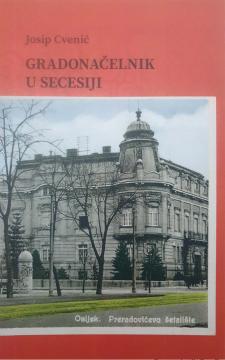
Gradonačelnik u secesiji

Gradonačelnik u secesiji

Josip Cvenić

In his latest novel, the author thematizes the time of Vjekoslav Hengl's mayoralty, from 1920 to 1934. It was a turbulent socio-political period, both for the city of Osijek and for the wider geopolitical space to which it belonged.

In a way, political and personal crises in the novel push Hengl forward, into a stubborn representation of city and national interests, only the occasional concession necessary for the functioning of the city, but, perhaps most significantly, also into the economic and infrastructural rise of the city on the Drava. Cvenić's writing, just like the previous novel, was partly inspired by the exhibition set up in the City and University Library in Osijek, today located in the very building where the Hengls lived, called "What Thildy and Vjekoslav Hengl were thinking", giving the author an insight into more documentary and photographic material, just like the one he researched in the State Archives in Osijek, the Museum of Slavonia, but also the sources from which he collected precious pieces of the cultural puzzle from which he drew, transferring historiographical data, personal reflections on time and space, man's role in his own and other people's lives, in the art of words.

Editor
Tatjana Ileš
Dimensions
20 x 13 cm
Pages
212
Publisher
Matica hrvatska, Osijek, 2022.
 
Latin alphabet. Paperback.
Language: Croatian.
ISBN
978-9-53242-147-7

Two copies are available

Copy number 1

Condition:Unused
Damages or inconvenience notice:
  • A message of a personal nature

Copy number 2

Condition:Used, excellent condition
Specificity of this instance:
Author signature
Dedication
 

Are you interested in another book? You can search the offer using our search engine or browse books by category.

You may also be interested in these titles

Udžbenik priča za završne razrede odrastanja

Udžbenik priča za završne razrede odrastanja

Josip Cvenić

Fairy tales are not rivers of the abyss, so at some time and in some country they don't exist, and then they appear again. No, they are everywhere and always present rivers of stories.

Slon, 1995.
Croatian. Latin alphabet. Paperback.
3.32
Kajinov pečat

Kajinov pečat

Josip Cvenić

Readers will stop at Cain's seal, whether they recognize themselves in the present time, or whether they are close to some trifle with which the biographies of his characters were woven.

Mozaik knjiga, 1997.
Croatian. Latin alphabet. Paperback.
3.32
Od Pola do Malnara: Putnici i istraživači u hrvatskoj kulturi od 13. do 20. stoljeća

Od Pola do Malnara: Putnici i istraživači u hrvatskoj kulturi od 13. do 20. stoljeća

Juraj Bubalo

The book by Zagreb travel writer and professor Juraj Bubalo is a kind of encyclopedia of Croatian travelers and explorers. Unique in Croatian non-fiction, it popularizes the culture of exploration and reminds us that Croats have been part of global discov

Meridijani, 2024.
Croatian. Latin alphabet. Hardcover.
28.32
Hrvatsko domobranstvo u Drugom svjetskom ratu

Hrvatsko domobranstvo u Drugom svjetskom ratu

Ivan Košutić

The book provides a detailed account of the development, organization, and operations of the Croatian Home Guard, the regular army of the Independent State of Croatia (NDH), in the period from 1941 to 1945.

Nakladni zavod Matice hrvatske, 1992.
Croatian. Latin alphabet. Hardcover with dust jacket.
11.56
1941. Godina koja se vraća

1941. Godina koja se vraća

Slavko Goldstein

The manuscript of author Slavko Goldstein is much more than memoir literature. It is actually an exceptional depiction of a turning point in recent Croatian history... (I. Banac)

Novi Liber, 2007.
Croatian. Latin alphabet. Hardcover with dust jacket.
28.56
Povijest Hrvatske 1945-2011. (2.svezak)

Povijest Hrvatske 1945-2011. (2.svezak)

Ivo Goldstein

Goldstein's "History of Croatia" is one of the most reliable books published in the past period, especially rich in historical works.

EPH media d. o. o., 2011.
Croatian. Latin alphabet. Paperback.
5.22