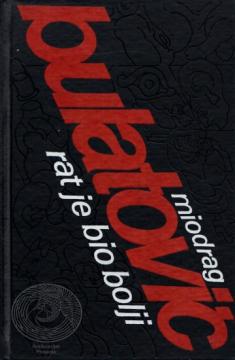
Sabrana dela V: Rat je bio bolji

Sabrana dela V: Rat je bio bolji

Miodrag Bulatović

Conceived and realized as a separate unit, this novel can also be interpreted as the second part of the book "A Hero on a Donkey". To a greater extent than in "Hero", here the war "which was better" is presented as a giant burlesque and as a pool of demon

The novel The War Was Better (published in 1977) is one of the most significant early works of Miodrag Bulatović, with which he entered the top of modernist prose in Yugoslav literature. The work depicts the absurdity and moral paradox of the time after the war — the moment when armed struggle ends, but spiritual destruction begins.

The action takes place in the post-war Montenegrin and Balkan environment, full of war veterans, defeated heroes and people who cannot find their peace. Through grotesque images and a sarcastic tone, Bulatović depicts characters who, having survived the war, lose the meaning of existence in peace. The war was terrible, but at least it gave the illusion of purpose and identity; peace, on the contrary, creates alienation, hypocrisy and inner emptiness.

The author uses recognizable elements of his style — a combination of brutal realism, fantastic visions and black humor. The characters are caricatures and symbols of a lost generation, while the events are charged with irony: those who fought for ideals now become hostages of greed and the meaninglessness of everyday life.

Bulatović thereby creates a powerful parable about a man who no longer knows how to live without conflict, because peace exposes true nothingness. The war was better is not only a commentary on the war experience, but also a philosophical presentation of the permanent human tendency towards destruction and self-annihilation. The novel is recognized as one of the most important anti-war works of South Slavic literature.

Editor
Petar Džadžić
Dimensions
20.5 x 13.5 cm
Pages
282
Publisher
Narodna knjiga, Beograd, 1984.
 
Latin alphabet. Hardcover.
Language: Serbian.

One copy is available

Condition:Used, very good condition
Damages or inconvenience notice:
  • Beschädigte Abdeckungen
 

Are you interested in another book? You can search the offer using our search engine or browse books by category.

You may also be interested in these titles

Jahač nad jahačima

Jahač nad jahačima

Miodrag Bulatović

Ein Roman über das Absurde, die Macht und den Untergang eines Mannes, der von Größenwahn besessen ist. In einer symbolischen, grotesken Welt enthüllt der Autor die Grausamkeit von Macht und Wahnsinn, in der Ehrgeiz und Angst die Grenze zwischen Mensch und

Partizanska knjiga, 1980.
Serbian. Latin alphabet. Hardcover with dust jacket.
9.997.49
Gullo Gullo

Gullo Gullo

Miodrag Bulatović

Gullo Gullo ist ein grotesk eindringlicher Roman über den moralischen und spirituellen Verfall eines Menschen. In einer Welt voller Gewalt, Angst und Absurdität irrt die Hauptfigur zwischen Leben und Tod, Gut und Böse umher, auf der Suche nach Sinn in ein

Prosveta, 1983.
Serbian. Latin alphabet. Hardcover with dust jacket.
2.82
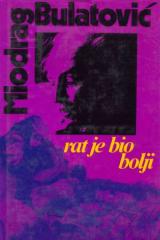
Rat je bio bolji

Rat je bio bolji

Miodrag Bulatović

Als eigenständiges Werk konzipiert und realisiert, kann dieser Roman auch als zweiter Teil des Buches „Der Held auf dem Esel“ interpretiert werden. Noch stärker als in „Der Held“ wird hier der Krieg, „der besser war“, als gigantische Burleske und als ein

Prosveta, 1983.
Serbian. Latin alphabet. Hardcover with dust jacket.
2.99
Svi ćemo izginuti

Svi ćemo izginuti

Hans Hellmut Kirst

„Wir werden alle umkommen“ (1957) ist ein katastrophaler Roman von Hans Hellmut Kirst, einem berühmten deutschen Schriftsteller, der durch seine Kriegstrilogie „08/15“ bekannt wurde. Es ist eine realistische, dokumentarische Darstellung des Ausbruchs des

Otokar Keršovani, 1961.
Croatian. Latin alphabet. Paperback.
6.324.74
Ženski orkestar

Ženski orkestar

Fania Fenelon

Fanie Fénelons Roman „Das Frauenorchester“ ist eine Autobiografie, in der sie ihre Überlebenserfahrungen in einem Frauenorchester im Konzentrationslager Auschwitz-Birkenau während des Zweiten Weltkriegs beschreibt.

Globus, 1985.
Croatian. Latin alphabet. Hardcover with dust jacket.
8.74
Iskra života

Iskra života

Erich Maria Remarque

„Der Funke des Lebens“ erzählt die Geschichte einer Gruppe von Häftlingen in einem nationalsozialistischen Konzentrationslager, die trotz des ständigen Terrors ihre moralische Stärke und Menschlichkeit bewahren. Der Roman schildert den Kampf des Geistes g

Minerva, 1986.
Serbian. Latin alphabet. Hardcover.
4.98