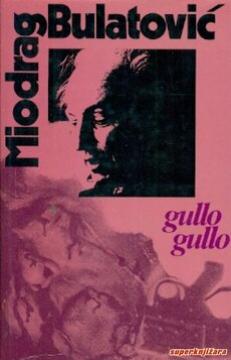
Gullo Gullo

Gullo Gullo

Miodrag Bulatović

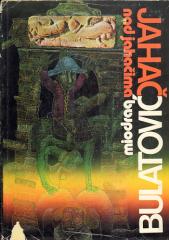
Gullo Gullo is a grotesquely powerful novel about the moral and spiritual decay of a human being. In a world of violence, fear and absurdity, the main character wanders between life and death, good and evil, in search of meaning in a tragically twisted re

The novel Gullo Gullo by one of the most famous Yugoslav novelists, Miodrag Bulatović, published in 1970, is the culmination of his creative world in which the combination of madness, magic and brutal reality turns into a powerful allegory of human evil. The title of the novel, derived from the onomatopoeia of screams and animal sounds, symbolizes the primal cry of a man deprived of reason, meaning and soul.

At the heart of the story is a series of characters—warriors, losers, criminals, and fanatics—moving through an apocalyptic dreamlike landscape. Through their destinies, Bulatović shows the dehumanization and moral collapse of a world where madness and violence have become everyday. The author creates an atmosphere of strong symbolism and the grotesque, mixing the real and the fantastic, the sacred and the demonic.

The themes of the novel include the absurdity of war, collective madness, religious and ideological blindness, as well as the senselessness of human suffering. Bulatović's expression is explosive and picturesque, full of metaphors, brutal images and a rhythm reminiscent of an oral epic. His characters are no longer realistically depicted people, but archetypes — bearers of evil, fear or remorse.

Gullo Gullo closes the trilogy begun with the novels Devils Are Coming and Rider of Riders, in which Bulatović develops his poetics of grotesque and existential anxiety to the extreme. The work remains a powerful literary vision of the collapse of humanity and of a man who, faced with his own demonic face, utters the last cry of civilization.

Dimensions
21 x 14 cm
Pages
246
Publisher
Prosveta, Beograd, 1983.
 
Distribution: 10,000 copies
 
Latin alphabet. Hardcover with dust jacket.
Language: Serbian.

One copy is available

Condition:Used, very good condition
Damages or inconvenience notice:
  • Slight damage to the cover
  • The cover is missing
 

Are you interested in another book? You can search the offer using our search engine or browse books by category.

You may also be interested in these titles

Jahač nad jahačima

Jahač nad jahačima

Miodrag Bulatović

A novel about the absurd, power and downfall of a man obsessed with greatness. In a symbolic, grotesque world, the author exposes the cruelty of power and madness in which ambition and fear blur the line between man and beast.

Partizanska knjiga, 1980.
Serbian. Latin alphabet. Hardcover with dust jacket.
9.99
Rat je bio bolji

Rat je bio bolji

Miodrag Bulatović

Conceived and realized as a separate entity, this novel can also be interpreted as the second part of the book "The Hero on the Donkey." To a greater extent than in "The Hero," here the war "which was better" is depicted as a gigantic burlesque and a pool

Prosveta, 1983.
Serbian. Latin alphabet. Hardcover with dust jacket.
2.99
Dok ležah na samrti

Dok ležah na samrti

William Faulkner

Faulkner's 1930 novel, a classic example of modernist literature. It is often compared to Joyce's "Ulysses" for its innovative structure, but is more accessible due to its focus on family.

Rad, 1985.
Croatian. Latin alphabet. Paperback.
3.26
Stotina godina (antikronika)

Stotina godina (antikronika)

Dario Harjaček

The novel One Hundred Years by Dario Harjaček provides a panoramic view of Trešnjevka and its inhabitants through a century of changes, ideologies, and human destinies – a mosaic of Zagreb in which life, art, and history intertwine.

Oceanmore, 2025.
Croatian. Latin alphabet. Paperback.
13.42
Rudnik čvaraka

Rudnik čvaraka

Tomislav Šovagović

The debut work of Croatian writer Tomislav Šovagović, awarded the Josip and Ivan Kozarac Award in 2012, is a dedication to Slavonia – the region of his childhood that the author, born in Dalmatia, observes with foreign but tender eyes.

Mozaik knjiga, 20112.
Croatian. Latin alphabet. Paperback.
11.56
Tri mušketira 1-2

Tri mušketira 1-2

Alexandre Dumas

Dumas' version of the story depicts the adventures of d'Artagnan and his friends from 1625 to 1628.

Epoha, 1966.
Croatian. Latin alphabet. Hardcover with dust jacket.
The book consists of two volumes
9.48