08/15: u kasarni / 08/15: u ratu / 08/15: do kraja
Rare book

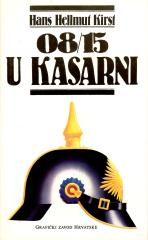
08/15: u kasarni / 08/15: u ratu / 08/15: do kraja

Hans Hellmut Kirst

Hans Hellmut Kirst's trilogy 08/15 follows soldier Asch from his life in the barracks, through the front and the post-war period. Through irony and dark humor, he exposes the senselessness of war, the moral collapse of the Wehrmacht, and a society that pr

Hans Hellmut Kirst, a former officer in the German army, in the trilogy 08/15 — consisting of the novels 08/15 in the barracks, 08/15 in the war and 08/15 to the end — describes the journey of Private Asch, a symbolic “little man” trapped in the mechanism of an authoritarian state. The title comes from the designation for a standard German machine gun, which denotes the typicality, monotony and impersonality of the military system.

In the first part, 08/15 in the barracks, Asch tries to survive among brutal sergeants and obedient colleagues. The barracks is depicted as a microcosm of the totalitarian system – a place of hierarchy, sadism and fear, where humor becomes the only form of resistance.

The second part, 08/15 in the war, takes place on the Eastern Front. Idealism and propaganda crumble before the scenes of destruction and death. Asch increasingly realizes that heroism in war does not exist – only survival and adaptation. Kirst here portrays the army as a morally buried institution that loses its purpose along with the people who make it up.

In the third part, 08/15 to the end, Asch observes how former Nazis easily adapt to the new political system, changing their uniforms but not their mentality. The system survives, only with new symbols — the people remain the same.

The trilogy is a sharp anti-war and anti-authoritarian satire, a combination of black humor and realistic psychology. Through it, Kirst created a portrait of a generation shaped by obedience, fear and hypocrisy — and asked the question: what remains of morality in a society that lives by orders?

Original title
08/15: in der Kaserne / 08/15: im Krieg / 08/15: bis zum Ende
Translation
Ljerka Linić-Šeferov, Slavko Novokmet
Editor
Nenad Popović
Illustrations
Mirko Ilić
Graphics design
Zoran Pavlović
Dimensions
19.5 x 12 cm
 
The book consists of 3 volumes.
Pages total
1096
Publisher
Grafički zavod Hrvatske (GZH), Zagreb, 1981.
 
Latin alphabet. Hardcover with dust jacket.
Language: Croatian.

No copies available

The last copy was sold recently.


Are you interested in another book? You can search the offer using our search engine or browse books by category.

You may also be interested in these titles

Osuđen na uspjeh

Osuđen na uspjeh

Hans Hellmut Kirst

In this work, the character of police inspector Keller appears for the first time, who fights crime with unusual methods.

Prosveta, 1987.
Croatian. Latin alphabet. Paperback.
4.98
Mladost za mlade: Kriminalistika

Mladost za mlade: Kriminalistika

Hans Hellmut Kirst

The book from the "Mladost" edition for young people brings criminal science closer to young people in a simple and entertaining way.

Mladost, 1972.
Croatian. Latin alphabet. Hardcover.
3.98
Dunav: P.S. 1991. vukovarske razglednice

Dunav: P.S. 1991. vukovarske razglednice

Pavao Pavličić

A moving and poignant chronicle of the siege and destruction of Vukovar in 1991 through 57 short "postcard" chapters. Pavličić does not write from the perspective of an "ordinary" Zagreb resident who spent the summer of 1991 in Vukovar, and then followed

Hena Com, 1999.
Croatian. Latin alphabet. Hardcover.
11.26
Odsustvo do buđenja

Odsustvo do buđenja

Leon Uris

Battle Cry (1953) is Leon Uris's debut novel based on his experience in World War II as a member of the 6th Marine Regiment.

Otokar Keršovani, 1970.
Croatian. Latin alphabet. Hardcover with dust jacket.
8.24
Sarajevski Marlboro / Karivani / Druge priče, 1992–1996

Sarajevski Marlboro / Karivani / Druge priče, 1992–1996

Miljenko Jergović

Along with the reissues of "Sarajevo Marlboro" and "Karivan", the book also contains a new cycle of stories by this author. These stories vividly portray characters, "little" people, witnesses of "big" history, and seemingly insignificant, but for them pi

Durieux, 1999.
Croatian. Latin alphabet. Paperback.
14.72
Romeo, Julija i tama

Romeo, Julija i tama

Jan Otčenášek

In occupied Prague in 1942, the student Pavel hides the wounded Jewish woman Hana. In danger and fear, a strong love is born between them. The Gestapo discovers them, Pavel dies tortured under investigation, and Hana survives the Holocaust carrying the me

Svjetlost, 1965.
Serbian. Latin alphabet. Paperback.
3.26